By Geoff McDonald, CEO & Co-Founder, Ambassador
Last week, I published a piece on the SaaSpocalypse and the shift from SaaS to Results-as-a-Service. The response was overwhelming — and the most common question I got was some version of the same thing:
"OK, I get it. RaaS makes sense. But how does the math actually work? And why can't every SaaS company just bolt on AI and start charging for outcomes?"
The short answer: because most of them don't have the infrastructure to deliver outcomes. They have the interface. They don't have the engine.
Let me explain — starting with the economics, and then the three things that separate the companies that will survive the SaaSpocalypse from the ones that won't.
The Cost Equation Nobody Wants to Talk About
Let's make this concrete.
A mid-market B2B company has a marketing coordinator managing their customer advocacy and referral program. That person's fully loaded cost — salary, benefits, payroll taxes, equipment, management overhead, office space allocation — is $95,000/year. Call it $8,000/month.
That coordinator spends their day doing roughly six things: monitoring customer sentiment to identify potential advocates, managing referral campaign logistics, writing and personalizing outreach, tracking which touchpoints actually drove conversions, reporting on program ROI, and iterating on what's working and what isn't.
Under the SaaS model, that company pays maybe $200-$500/month for referral software. The software helps the coordinator do their job. It does not do their job. The real cost of running the program isn't the $6,000/year in software. It's the $95,000/year in headcount. The software represents roughly 6% of the total program cost.
Now here's the RaaS math.
If an AI agent platform can autonomously handle 70-80% of that coordinator's workflow — signal capture, campaign execution, attribution, optimization, reporting — the company doesn't need a full-time person dedicated to that function anymore. Maybe they need 20% of that person's time for oversight, strategic direction, and relationship management. The rest of the role gets absorbed by the platform.
The company's cost goes from $95,000 (human) + $6,000 (software) = $101,000 down to $19,000 (20% of the human's time reallocated) + $30,000-$40,000 (RaaS platform fee) = $49,000-$59,000.
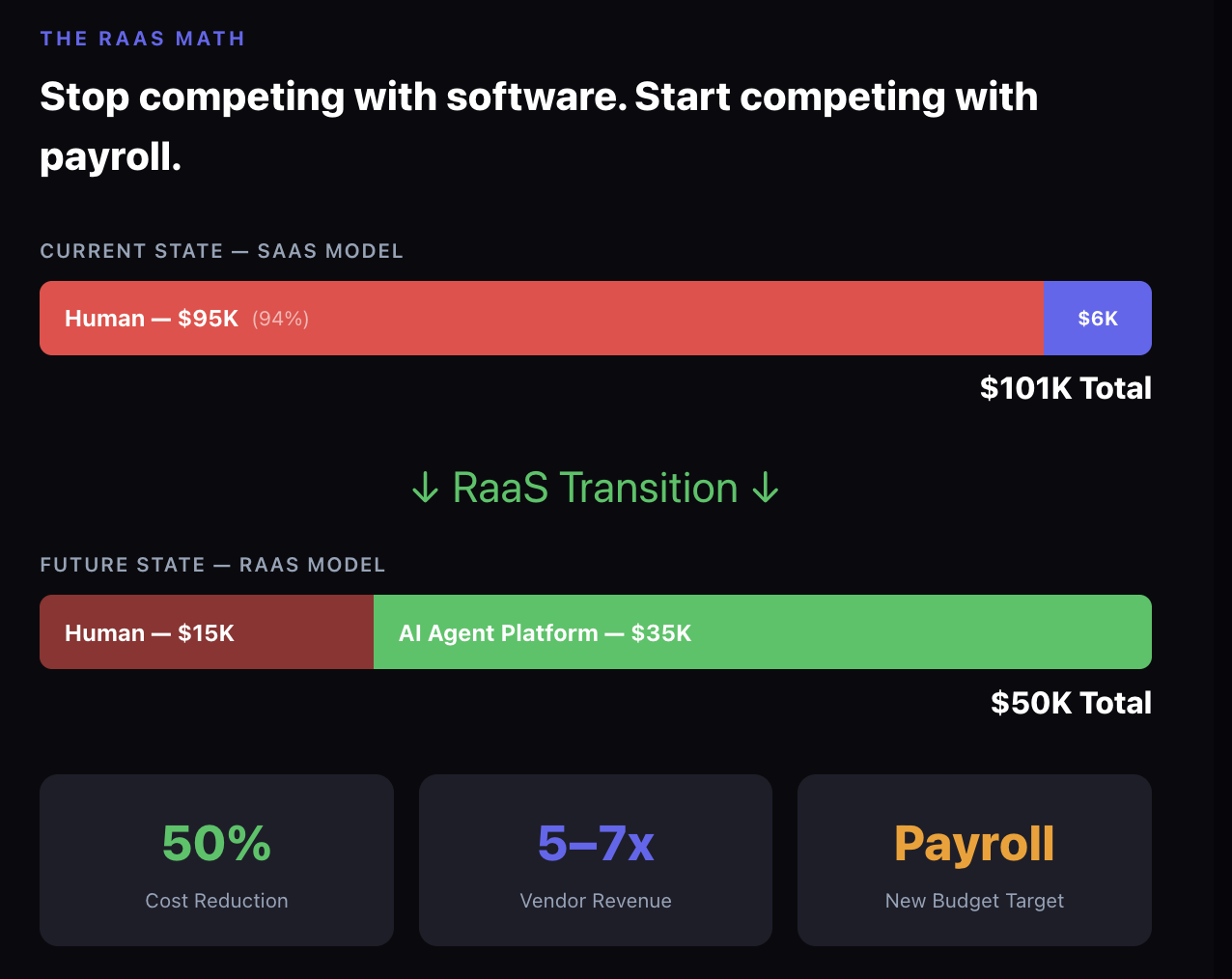
That's a 40-50% reduction in total program cost. And the outcomes aren't just maintained — they improve, because the AI agents operate 24/7, don't have bad weeks, and compound in intelligence over time.
For the RaaS vendor, the economics are equally compelling. You've gone from a $6,000/year contract to a $30,000-$40,000/year contract. Your revenue per customer increased 5-7x. Not because you raised prices — because you changed what you're pricing against. You moved from the software budget to the payroll budget. And payroll is always the bigger number.
This is why RaaS isn't just a pricing trend. It's a fundamental restructuring of where enterprise software captures value.
But Here's the Problem
Every SaaS company on the planet is reading the same headlines. They all see the SaaSpocalypse. They all want to claim they're "AI-powered." They all want to charge more.
Most of them will fail at this transition. And it won't be because they don't understand the opportunity. It'll be because they don't have the infrastructure to deliver on it.
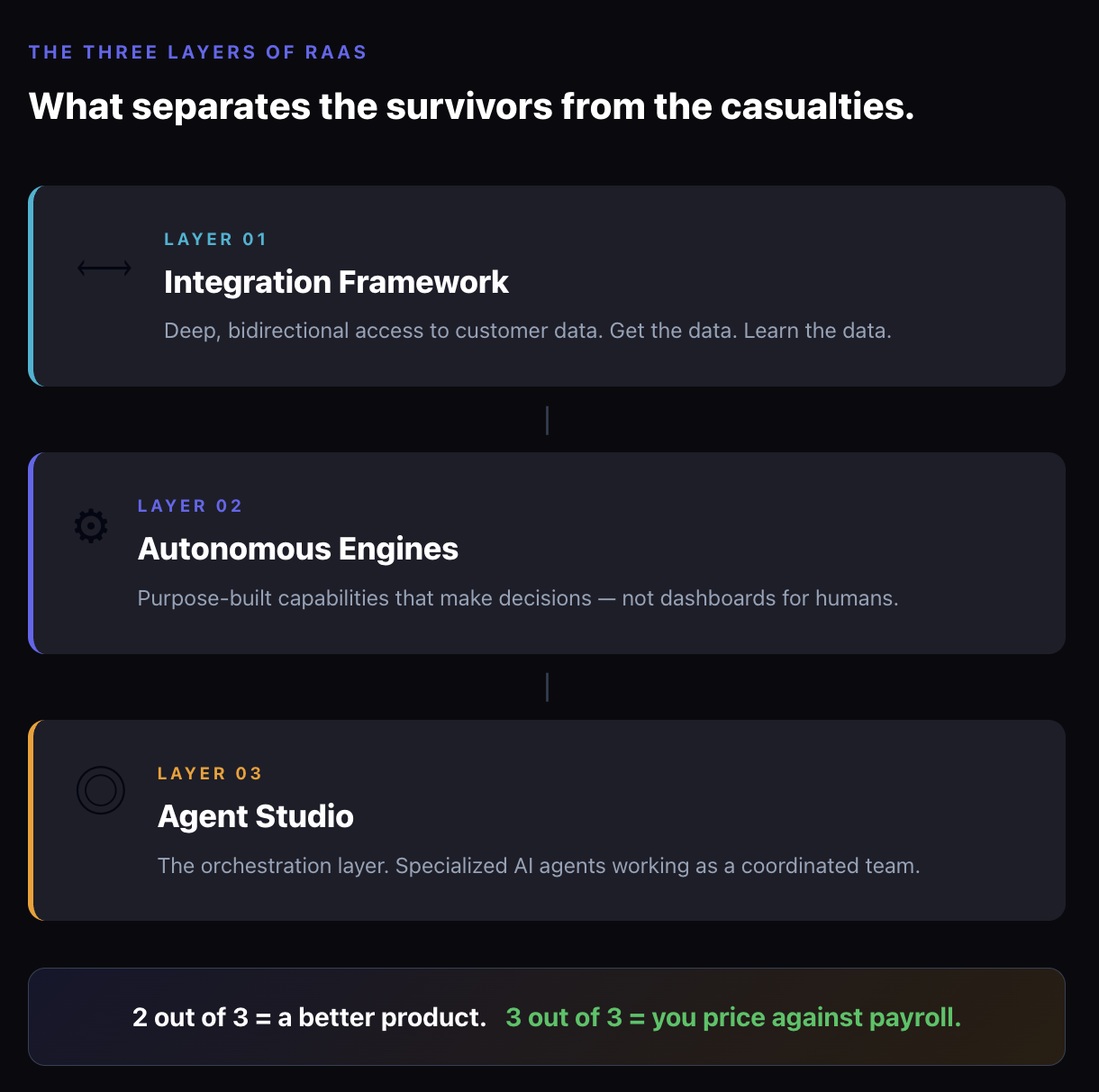
After a year of building through this shift, I believe there are exactly three things that separate the SaaS companies that will successfully transition to RaaS from the ones that will get left behind. You need all three. Two out of three gets you a better product. Three out of three gets you a business that can credibly replace a human.
1. The Integration Framework: You Have to Get the Data and Learn the Data
This is where most AI-powered SaaS companies fall down before they even start.
If you want to deliver autonomous outcomes for a customer, you need to be deeply embedded in their data ecosystem. Not surface-level API connections that pull a few fields from their CRM. Deep, bidirectional integrations across every system that touches the workflow you're trying to automate.
For customer growth, that means CRM data, marketing automation data, product usage data, support interactions, NPS scores, transaction history, communication logs, website behavior, social signals. You need all of it. And you need it flowing in real time, not in nightly batch syncs.
But getting the data is only half the problem. You also have to learn the data.
Every company's data is different. Their CRM is structured differently. Their customer segments behave differently. Their sales cycles have different cadences. Their definition of a "good" referral is different. An AI agent that treats every customer's data the same way will produce generic outputs that no enterprise buyer will trust with autonomous decision-making.
The integration framework isn't just plumbing. It's the foundation of intelligence. It's what allows the system to understand this specific company's customers, this specific company's patterns, this specific company's definition of success. Without it, your AI is just running the same prompts against the same foundation model as everyone else — and that's not worth a payroll-level price tag.
This is the part of the stack that takes years to build well. It's not glamorous. It doesn't demo well on a sales call. But it is the single biggest determinant of whether your AI agents will actually produce results that are good enough to replace a human. The companies that skipped this step to rush an AI feature to market are going to discover very quickly that "AI-powered" doesn't mean "outcome-capable."
2. The Engines: You Have to Have the Features That Actually Do the Work
Integration gets you the data. But data without capability is just a data warehouse with a chatbot on top.
The second requirement is having purpose-built engines — specialized functional capabilities that each handle a distinct part of the workflow you're automating. At Ambassador, we call these engines. Other companies might call them modules, capabilities, or features. The label doesn't matter. What matters is that each one does something specific, does it well, and was built to operate autonomously.
This is fundamentally different from the traditional SaaS feature set. In the SaaS model, features were built to help humans do things faster. Dashboards to visualize data. Editors to create campaigns. Reports to summarize performance. Every feature assumed a human in the loop making decisions.
RaaS engines have to be built differently. They have to make decisions. A signal engine doesn't just show you which customers are exhibiting advocacy behavior — it identifies them, scores them, and passes them to the next engine automatically. A campaign engine doesn't just give you a template — it creates the outreach, personalizes it, selects the channel, determines the timing, and launches it. A measurement engine doesn't just show you a funnel — it attributes outcomes across multiple touchpoints and feeds that attribution data back into the system to improve the next cycle.
Each engine has to be capable of operating without a human telling it what to do next. That's a much higher bar than "we have a feature for that."
And critically, these engines have to work together. A signal engine that doesn't feed into a prediction engine is just an alert system. A campaign engine that doesn't receive input from a prediction engine is just a blast tool. The value of the engine architecture isn't in any single engine — it's in how they connect, how they pass intelligence between each other, and how the output of one becomes the input of the next.
This is why companies that built narrow point solutions are going to struggle in the RaaS transition. If you only do one thing — even if you do it well — you can't credibly automate a workflow. Workflows are multi-step. They require multiple capabilities working in sequence. A company with one engine and a ChatGPT wrapper is still going to need the customer to hire humans for every other step.
The companies that invested in building broad, interconnected capability sets — even when the market was rewarding single-feature simplicity — are the ones positioned to deliver complete autonomous outcomes.
3. The Agent Studio: You Have to Bring It All Together
Integration gives you the data. Engines give you the capabilities. But the thing that actually replaces the human is the orchestration layer — what we call Agent Studio.
This is where specialized AI agents are assembled, configured, and deployed to work together as a team. Think of it as the difference between hiring individual freelancers who each do one task versus hiring a coordinated team that communicates, shares context, and operates toward a common goal.
An Agent Studio does several things that neither integrations nor engines can do alone.
It orchestrates. It determines which engine needs to fire, in what order, with what inputs, based on what's happening in real time. The marketing coordinator who used to do this was essentially a human orchestration layer — reading signals, deciding what to do next, executing across multiple tools, and adjusting based on results. The Agent Studio replaces that orchestration function entirely.
It contextualizes. Each agent in the studio has access to the full context of what every other agent has done and learned. When the campaign agent launches outreach, it knows what the signal agent identified, what the prediction agent forecasted, and what the measurement agent learned from the last cycle. A human coordinator kept this context in their head (or more likely, in a messy spreadsheet). The Agent Studio keeps it in a shared intelligence layer that never forgets and never loses nuance.
It compounds. This is the most important part. Every cycle through the Agent Studio — from signal to prediction to action to measurement to learning — creates proprietary intelligence that makes the next cycle better. We call this circular data. It's the reason the system gets more valuable over time, and it's the reason the switching cost isn't a contract negotiation — it's the loss of accumulated intelligence that took months to build.
And it scales. A human coordinator can manage one program, maybe two. An Agent Studio can run dozens of specialized agent configurations simultaneously, each tuned to different customer segments, different campaign types, different objectives — all learning from each other.
This is the layer that makes RaaS pricing credible. Without it, you're still selling tools that require humans. With it, you're selling a digital workforce that delivers outcomes.
Why You Need All Three
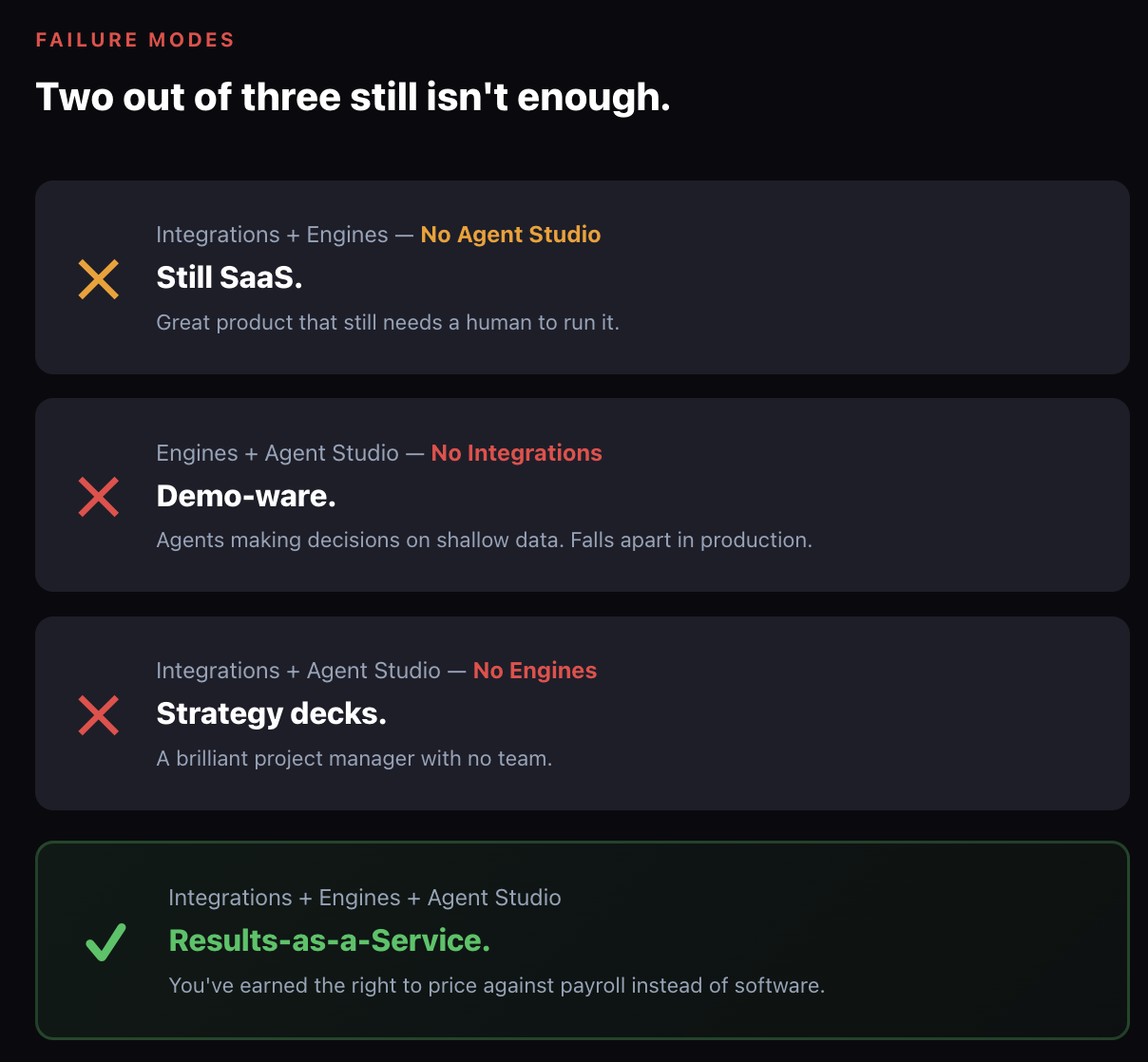
Here's why two out of three doesn't work.
Integrations + Engines, No Agent Studio: You have a great product. Rich data, strong capabilities. But someone still has to operate it. You're still SaaS — a better version of SaaS, but SaaS nonetheless. You can't credibly charge against payroll because you're not replacing the person. You're making them more productive. That's a $500/month value proposition, not a $3,000/month one.
Integrations + Agent Studio, No Engines: You have a smart orchestration layer sitting on top of raw data with nothing to orchestrate. Your agents can reason and plan, but they can't execute. It's like hiring a brilliant project manager and giving them no team. The output is strategy decks, not results.
Engines + Agent Studio, No Integrations: You have powerful capabilities and smart orchestration, but you're working with generic data. Your agents are making decisions based on shallow, incomplete, or stale information. The outputs look impressive in a demo but fall apart in production because they don't reflect the customer's actual business reality. This is where most "AI-native" startups land — flashy agents, thin data, inconsistent results.
The companies that survive the SaaSpocalypse are the ones that invested in all three layers, often over years, before the market realized they'd need them.
The Uncomfortable Truth
Building for RaaS is hard. It requires years of integration work that doesn't show up in product demos. It requires building multiple interconnected engines when the market was rewarding single-feature simplicity. It requires an orchestration layer sophisticated enough to replace human judgment, not just human labor.
Most SaaS companies didn't build this way. They built dashboards. They built tools. They built features designed to make humans more efficient, not to make humans optional.
And now they're trying to bolt AI onto that architecture and call it transformation.
The market can tell the difference. That's why Bloomberg is calling it the SaaSpocalypse. That's why Salesforce has been cut in half. That's why investors are asking which companies survive.
The answer isn't the ones with the best AI features. It's the ones with the deepest integrations, the broadest autonomous engines, and the orchestration layer that brings it all together.
Integration. Engines. Agent Studio.
That's the stack that survives. That's the stack that delivers results. And that's the stack that earns the right to price against payroll instead of software.
Welcome to the results economy.
This is Part 2 of a series on the SaaS to RaaS transition. Read Part 1: The SaaSpocalypse Is Here. Results-as-a-Service Is What Comes Next.