By Geoff McDonald, CEO & Co-Founder, Ambassador
Bloomberg just gave it a name.
On February 19th, Bloomberg's Odd Lots podcast — one of the most influential finance and economics shows in the world — aired an episode titled "Jared Sleeper on Which Software Companies Will Survive the 'SaaSpocalypse.'" Host Joe Weisenthal opened by noting that IGV, the software ETF, was down another 3% that day alone. Co-host Tracy Alloway pointed to Salesforce — the company that literally invented the modern SaaS playbook — noting it had been "basically cut in half" from its peak.
Then Alloway said something that should keep every SaaS founder up at night:
"Sort of like emblematic... a software company that I'm not really sure what they do."
Weisenthal's blunt summary? "SaaS is trash."
The episode brought on Jared Sleeper, a venture investor, to dissect which software companies would survive this reckoning and which wouldn't. The thesis was clear: the old model of selling access to software on a per-seat, per-month basis is collapsing. The market isn't having a bad quarter. It's repricing an entire category.
We've been saying this for over a year. And we built Ambassador Platform 3.0 specifically for what comes next.
🎧 Listen to the full episode: Jared Sleeper on Which Software Companies Will Survive the "SaaSpocalypse" — Odd Lots, Bloomberg Podcasts (February 19, 2026)
The Model Is Breaking — And Everyone Can See It Now
For 20 years, SaaS worked because it was better than what came before it. You replaced expensive on-premise installations with affordable monthly subscriptions. You charged per seat, per month. Customers still hired the people to sit in those seats — your software just made them marginally faster.
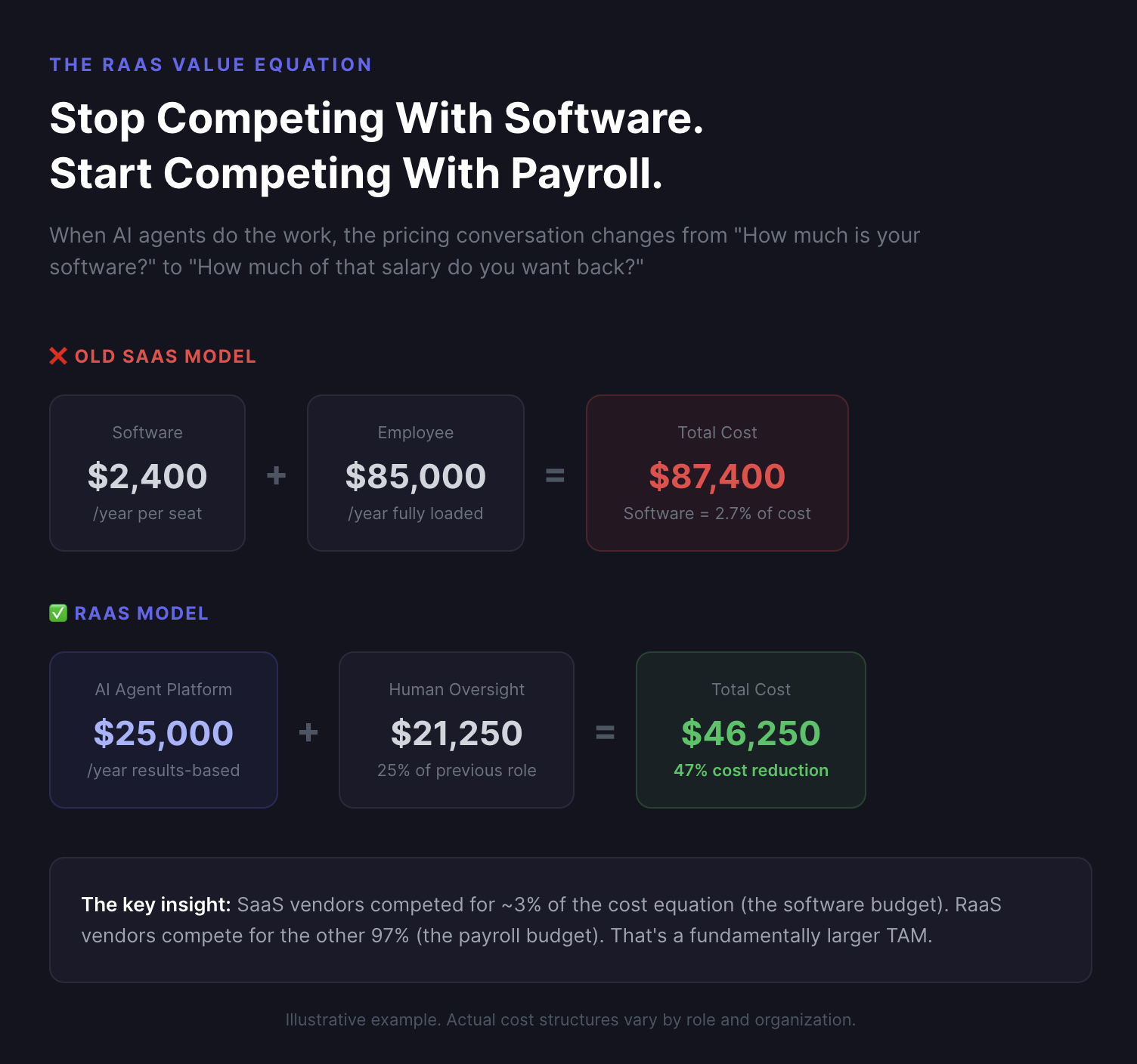
But here's the thing nobody wanted to say out loud: SaaS never eliminated the biggest cost. The human. Your $200/month software license sat on top of a $75,000/year employee. The tool made that person 20% faster, maybe 30% if they were a power user. But the line item on the P&L that actually mattered — headcount — never moved.
Agentic AI just changed that math permanently.
When Bloomberg is dedicating full podcast episodes to the question of which software companies will survive, the market is telling you this isn't a blip. When the poster child of SaaS has lost half its value and a prominent financial journalist says she's "not really sure what they do," that's not a stock correction. That's a value proposition correction.
The companies still charging per seat for tools that require humans to operate them are watching their moats evaporate in real time.
What Replaces SaaS? Results.
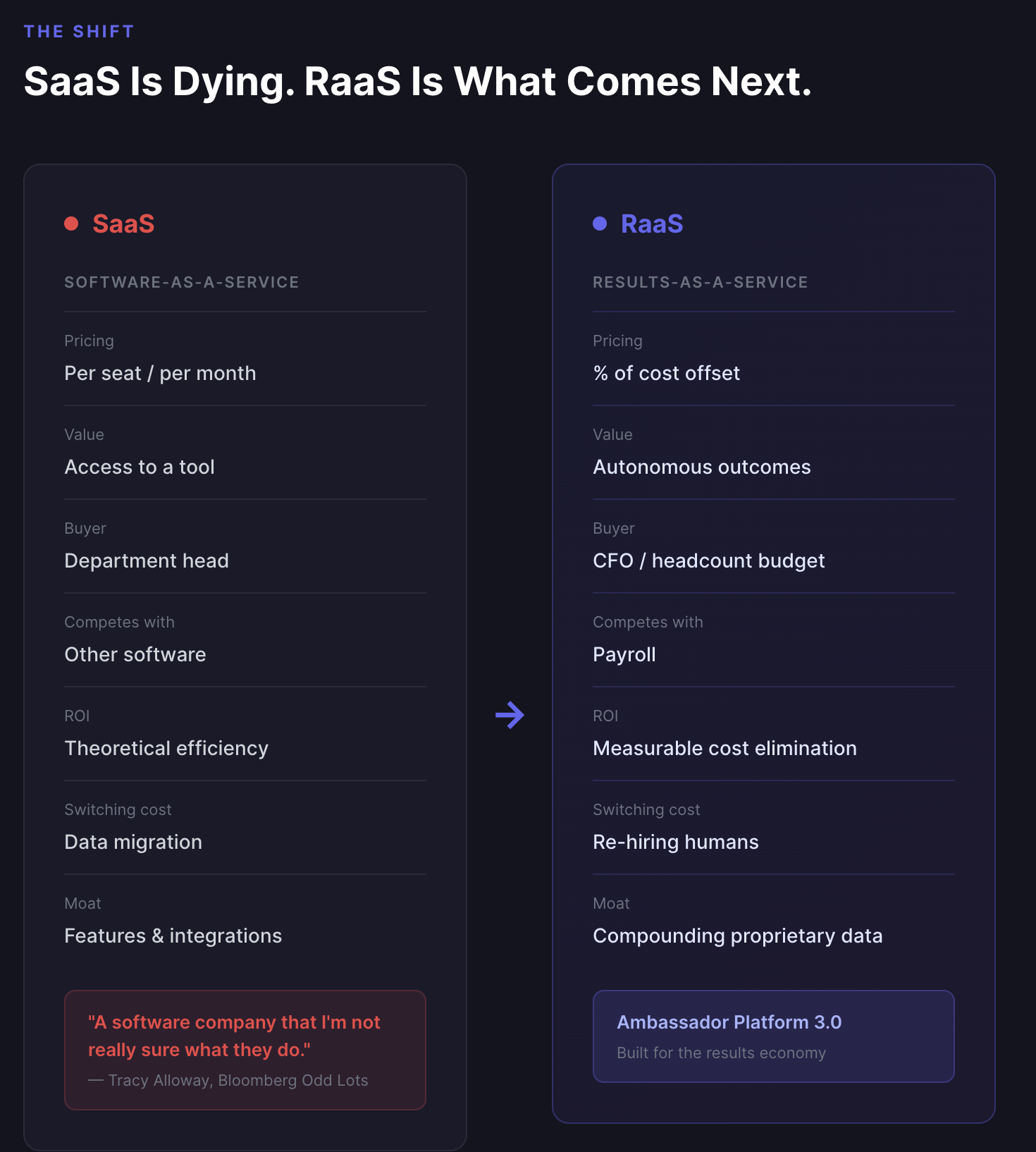
We believe the answer is RaaS — Results-as-a-Service.
The shift is fundamental. The best software companies aren't selling tools anymore. They're selling the elimination of a cost — specifically, the fully loaded cost of the employee who used to do the work the software now does autonomously.
When your platform can deploy AI agents that actually DO the work — not just make the work easier — the entire value equation flips. You're no longer saving someone 5 hours a week. You're replacing a $70K, $90K, $120K role. Partially or fully.
And when that's the value you're delivering, why would you charge $199/seat/month?
You charge a percentage of the cost you're offsetting. That's results-based pricing. And it changes everything about how software is sold:
The buyer changes. It's no longer a department head comparing you to Competitor X on G2. It's a CFO looking at headcount projections and seeing an opportunity to redeploy capital.
The ROI becomes undeniable. It's not a theoretical efficiency gain buried in a business case. It's "we had 4 people doing this, now we have 1 person plus your agents."
Contract values expand dramatically. Because you're priced against salary, not software. Payroll is a much, much bigger budget than the software line item.
Churn fundamentally changes. The switching cost isn't migrating data to another tool. It's re-hiring humans. That's a moat no feature comparison can overcome.
This is what the Odd Lots episode is really about. It's not just that software stocks are down. It's that the market is finally pricing in the reality that "access to a tool" is no longer worth what it used to be — because AI agents are making the tool-plus-human model obsolete.
Why Ambassador Is Built for This Moment
When we launched Ambassador Platform 3.0 in October 2025, we didn't add AI features to our existing referral software. We rebuilt the entire value delivery model from the ground up.
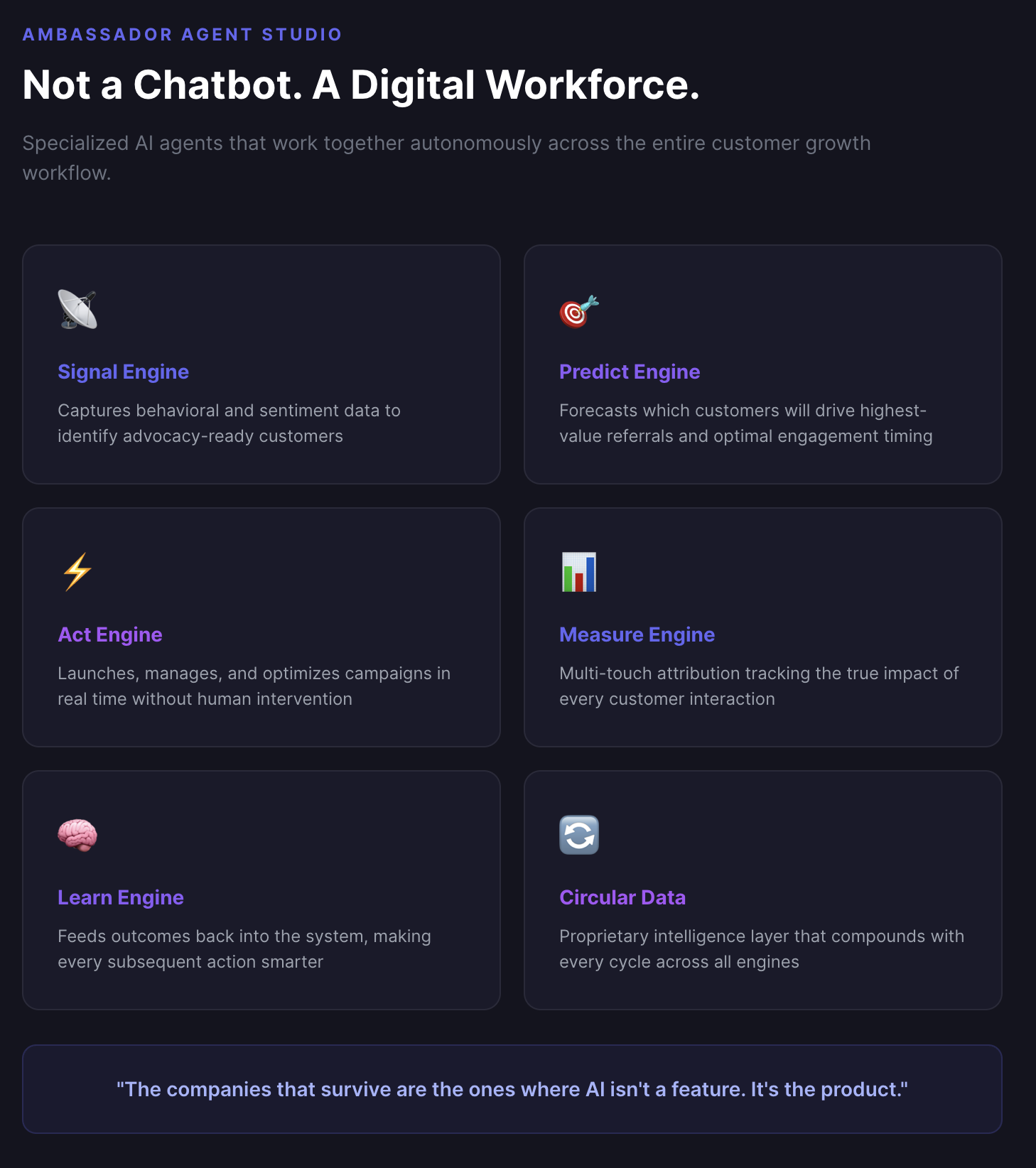
Our platform deploys interconnected AI agents — through what we call Agent Studio — that autonomously manage the complete customer growth workflow. This isn't a chatbot. This isn't a copilot that suggests things for a human to approve. This is an autonomous system where specialized agents work together across the entire feedback-to-revenue cycle:
One agent captures customer signals — the behavioral and sentiment data that indicates who's ready to advocate. Another agent predicts which customers will drive the highest-value referrals and when to engage them. Another launches, manages, and optimizes campaigns in real time without human intervention. Another handles multi-touch attribution — solving one of the hardest problems in marketing by tracking the true impact of every customer interaction. Another learns from every outcome and feeds that intelligence back into the system, making every subsequent action smarter.
This is the architecture that makes results-based pricing credible at scale. A single AI feature bolted onto a dashboard can't promise business outcomes. But an interconnected system of eight specialized engines — Signal, Predict, Act, Measure, Learn — sitting on top of proprietary data that compounds with every interaction? That can.
And that compounding data layer is the key to everything.
The Moat That Matters: Circular Data
The Odd Lots episode raises the right question: which software companies survive the SaaSpocalypse? We believe the answer comes down to one thing — the data architecture underneath the AI.
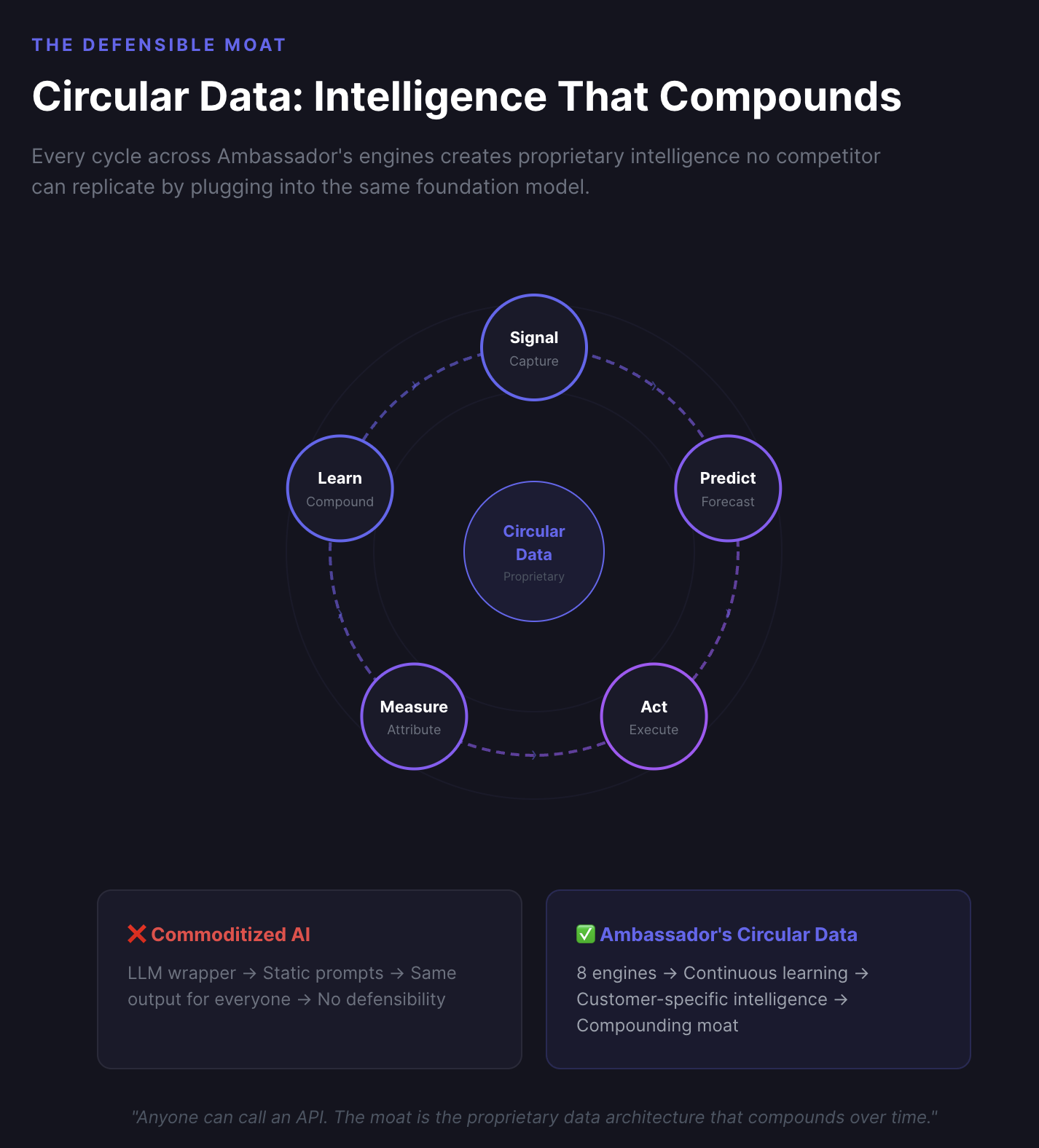
Anyone can call an LLM API. Anyone can build a chatbot. The models are commoditized. What can't be replicated is a proprietary data layer that connects multiple specialized agents, learns from every customer interaction, and creates intelligence that is unique to each business.
We call this circular data. It's the continuous feedback loop that flows across all of Ambassador's engines — from signal capture to prediction to action to measurement to learning and back again. Every cycle makes the system smarter. Every customer interaction adds to an intelligence layer that no competitor can shortcut by plugging into the same foundation model.
This is fundamentally different from the SaaS companies that are bolting AI onto existing products and hoping the market doesn't notice. Those companies are the ones Weisenthal and Alloway are talking about. Those are the ones investors are repricing.
The companies that survive — the ones Jared Sleeper is looking for on that podcast — are the ones where AI isn't a feature. It's the product. Where the data gets more valuable over time. Where the switching cost isn't a contract term — it's the accumulated intelligence the system has built around your specific business.
That's Ambassador.
The Future of Feedback Is Autonomous
Customer feedback has always been the most underleveraged asset in business. Companies collect it. They store it. They occasionally read it. And then it sits in a dashboard somewhere, waiting for a human to do something with it.
The RaaS model — powered by Agent Studios — changes that entirely. Feedback becomes the fuel for an autonomous growth engine. Every piece of customer sentiment, every behavioral signal, every referral outcome feeds into a system that acts on it without waiting for a human to interpret a chart.
This is where Ambassador is headed. Not as a tool that helps marketing teams manage referral programs. As an autonomous growth platform where customer feedback becomes self-driving revenue.
Since launching 3.0, we've seen our upsell conversion rates from existing clients increase significantly — not because we added features, but because the autonomous outcomes speak for themselves. When clients can see the system working without their team having to operate it, the value conversation changes completely.
The SaaSpocalypse Isn't the End. It's the Beginning.
Bloomberg is right to call this a reckoning. The SaaS model served its purpose for two decades, and the companies that built it deserve credit for transforming how software is delivered.
But the market is telling us clearly — through stock prices, through investor sentiment, through episodes like Odd Lots bringing on venture investors to sort survivors from casualties — that the next era belongs to companies that deliver results, not access.
Results-based pricing. Autonomous AI agents. Proprietary data architectures that compound over time. Agent Studios that deploy specialized AI teams instead of selling seats to human ones.
That's the future of software. That's the future of customer growth. And that's what we're building at Ambassador.
SaaS gave us access to tools. RaaS gives us access to results.
Welcome to the results economy.
Referenced: "Jared Sleeper on Which Software Companies Will Survive the 'SaaSpocalypse'" — Odd Lots, Bloomberg Podcasts. February 19, 2026. Listen to the full episode →