By Geoff McDonald, CEO of Ambassador
The way software gets priced is changing faster than most teams realize. The part nobody is ready for is what that change demands of measurement.
For twenty years, software had one billing unit that mattered. The seat. More people using it, more money. It was clean, it was predictable, and it was completely disconnected from whether the software actually did anything.
That era is ending, and the numbers are not subtle.
The seat is losing its grip
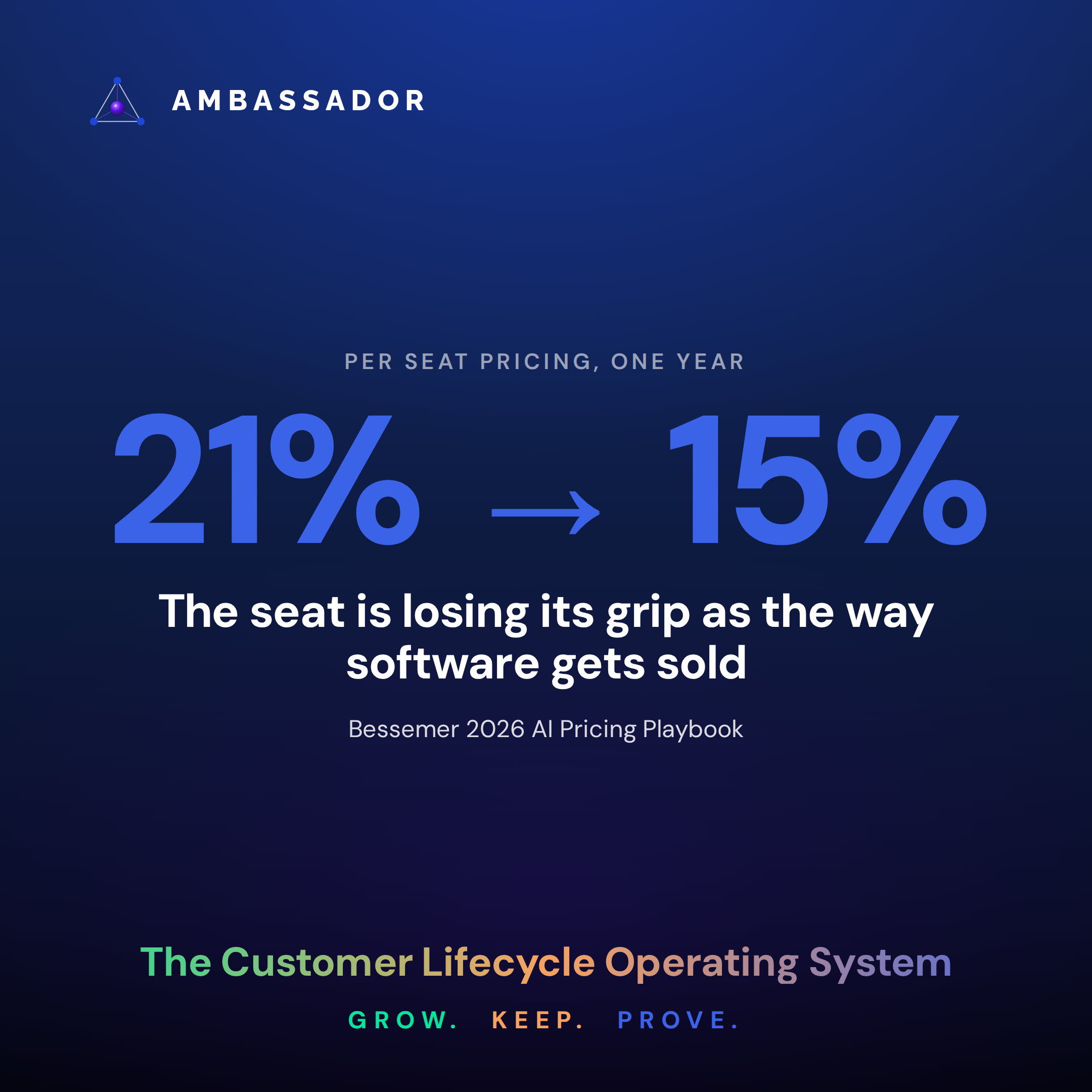
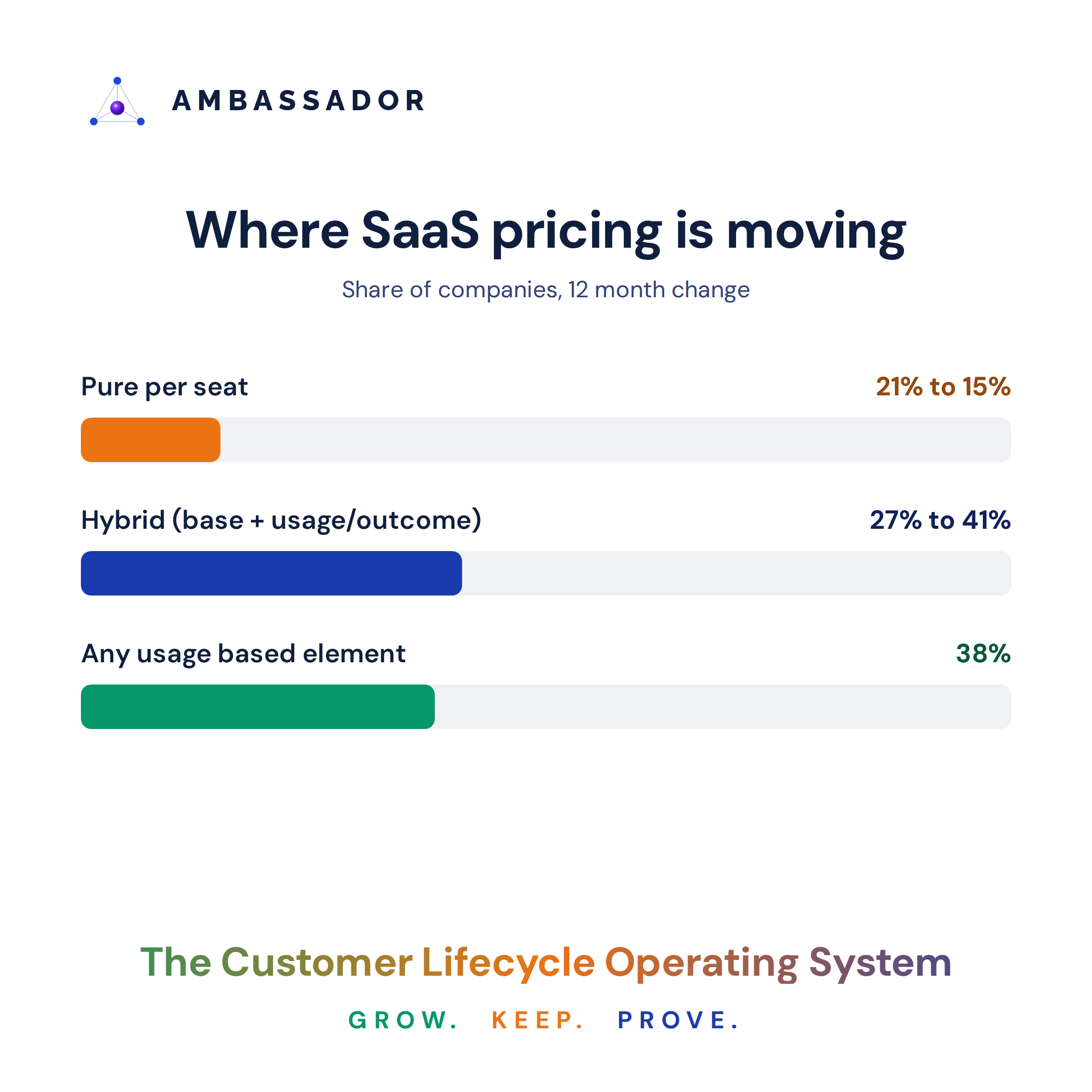
Bessemer's 2026 AI Pricing Playbook, which tracks the shift across more than 200 AI vendors, reports that pure per-seat pricing fell from 21% of companies to 15% in a single year. Hybrid models, the ones that blend a base fee with usage or outcomes, rose from 27% to 41% over the same window.
This is not a fringe experiment anymore. Usage-based pricing now shows up in some form at 38% of SaaS companies, up from 27% in 2023. A Futurum survey of enterprise buyers in the first half of 2026 found that fewer than one in five still prefer classic per-user pricing, and that vendors locked into seat-only models now risk being disqualified before the conversation even starts.
Jason Lemkin put it plainly in August: "'Just seats' as the whole model is done." His reasoning is the part worth sitting with. Seat pricing was always a proxy. Headcount stood in for how much work was getting done, and for two decades that proxy held. When an agent does the work instead of a person, the proxy breaks. You are not paying for a login anymore. You are paying for an outcome.
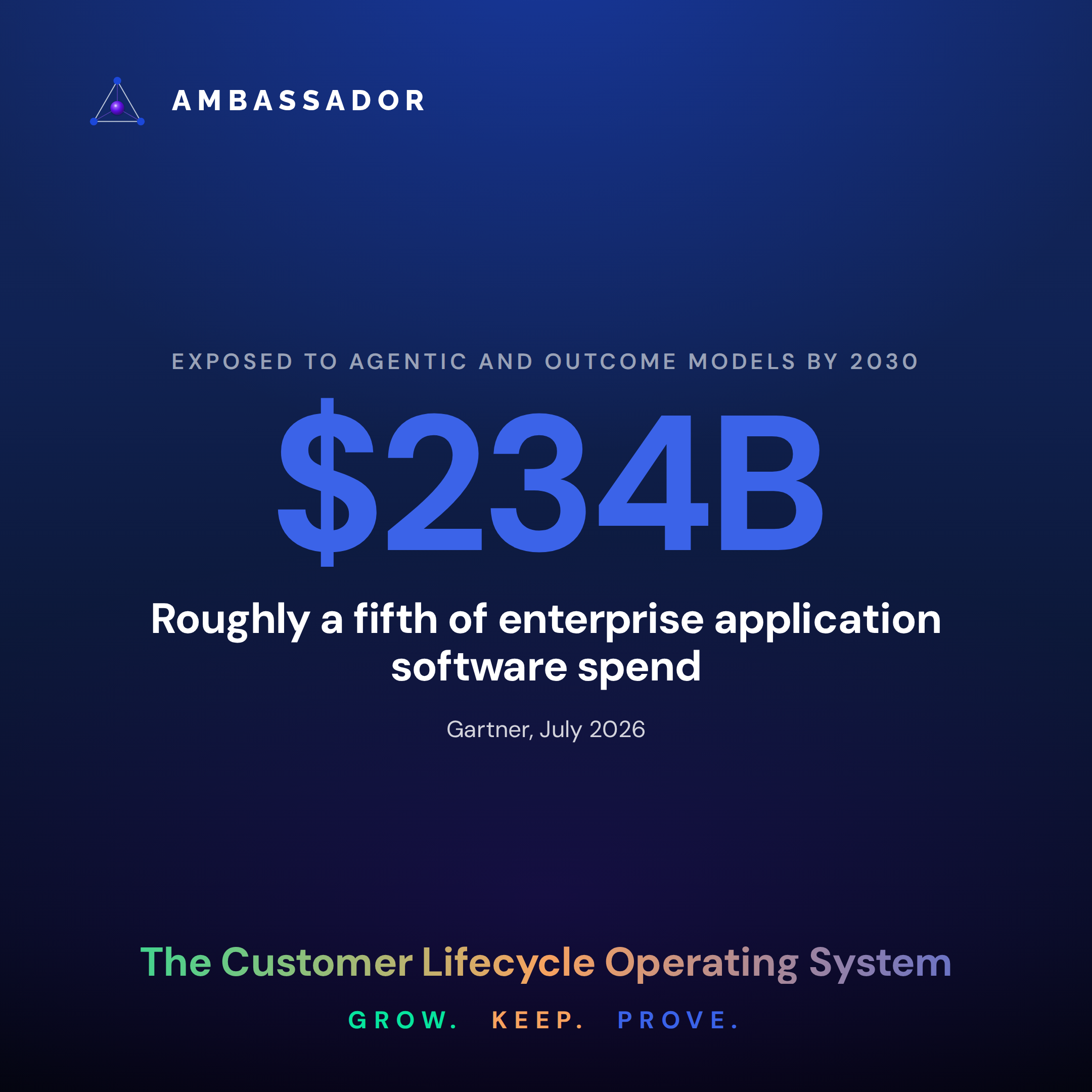
Gartner attached a number to the stakes. In a July 2026 release, the firm estimated that up to $234 billion of enterprise application spend is exposed to the shift toward agentic and outcome-based models by 2030, roughly a fifth of enterprise application software spend. As Gartner's George Brocklehurst framed it, you are no longer buying software primarily for people. You are increasingly buying it for agents. That breaks the link between user growth and revenue growth that most software companies were built on.
The hidden prerequisite nobody puts on the slide
Here is the part that gets lost in the excitement.
When you priced by the seat, the bill was boring and predictable. You knew the number before the month began. When you price by consumption or outcome, the bill becomes a living thing. It moves. And the only way that model stays healthy, for the buyer and the vendor both, is if each side can see clearly what drove it.
That is a measurement problem, and most companies are not ready for it.
Outcome-based pricing has a prerequisite that rarely makes it onto the pitch deck: you have to be able to prove the outcome. Cleanly, defensibly, in a way both sides trust. Consumption pricing without airtight measurement is not modern pricing. It is a variable invoice with extra anxiety. The buyer cannot tell what they are paying for. The vendor cannot stand behind the value. Trust erodes on both sides, and a good model gets a bad name it never earned.
So the pricing conversation everyone is having is actually a measurement conversation wearing a different hat.
And measurement is quietly getting harder
Just as the business model starts to depend on measurement, the ground under measurement is shifting.
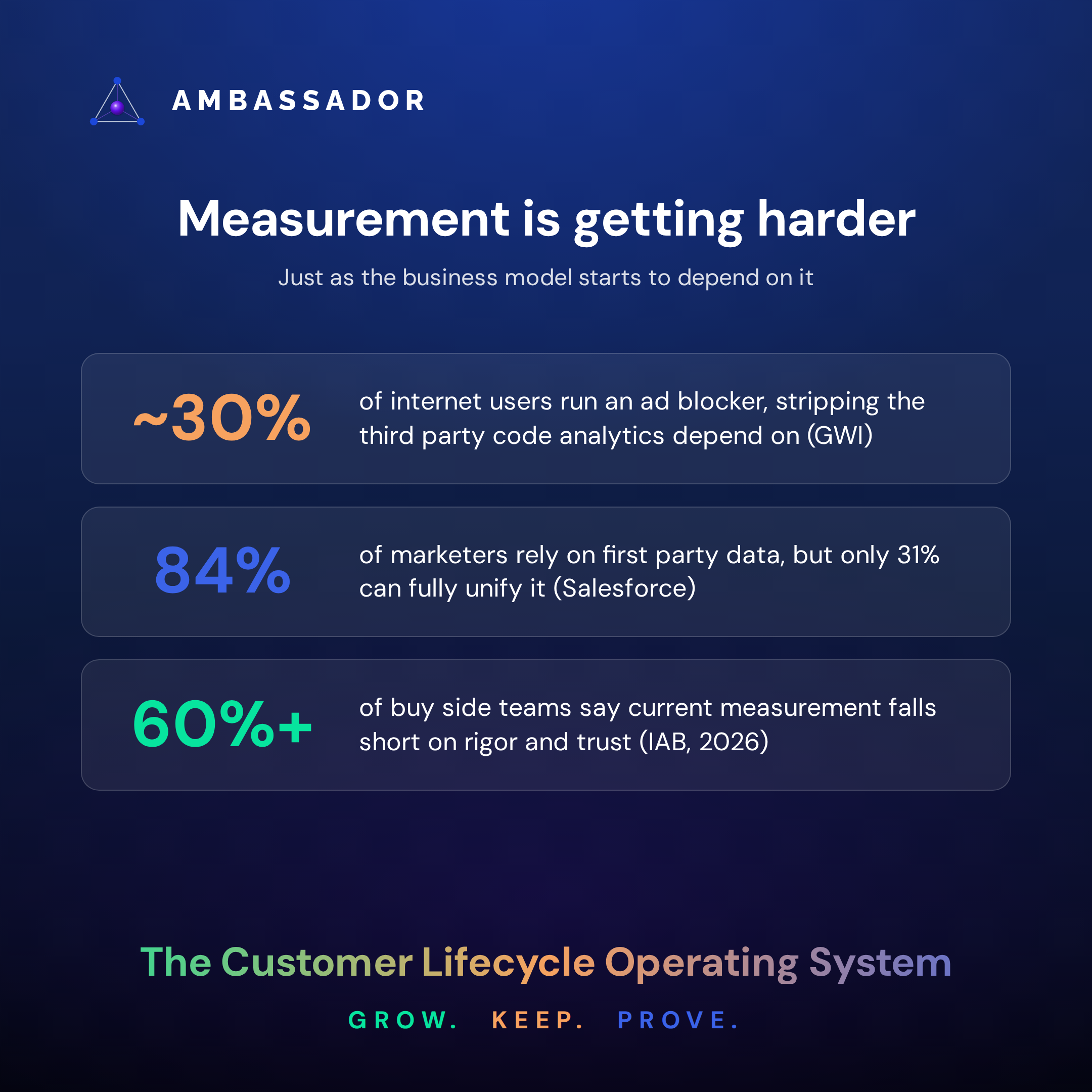
Start with the simplest erosion. Nearly a third of internet users, about 29.5% worldwide per GWI, now run an ad blocker. Those blockers do not just remove ads. They strip the third-party tracking code that analytics tools depend on. When that code does not run, a real chunk of customer behavior never makes it into the report at all.
The teams that feel this first are the ones with the best economics. Word of mouth. Referral. The advocate who sent you a customer and got erased on the way in because their friend used a browser that blocked the code that would have credited them. Your highest-value channel, by economics, becomes your least-visible channel, by measurement. And what you cannot see, you underfund by accident.
It is not only blockers. The IAB reported in early 2026 that a majority of buy-side teams believe their current measurement, even the AI-powered kind, falls short on rigor and trust. Salesforce found that while 84% of marketers now lean on first-party and customer data, only 31% are fully satisfied with their ability to unify it. Everyone knows first-party is the answer. Almost no one has the plumbing to make it hold together.
Why this is really one story
Put the two halves together and the picture is clear.
Pricing is moving toward outcomes. Outcomes require proof. And proof is getting harder to produce exactly when the business model starts to depend on it. These are not two trends. They are one trend, seen from two angles.
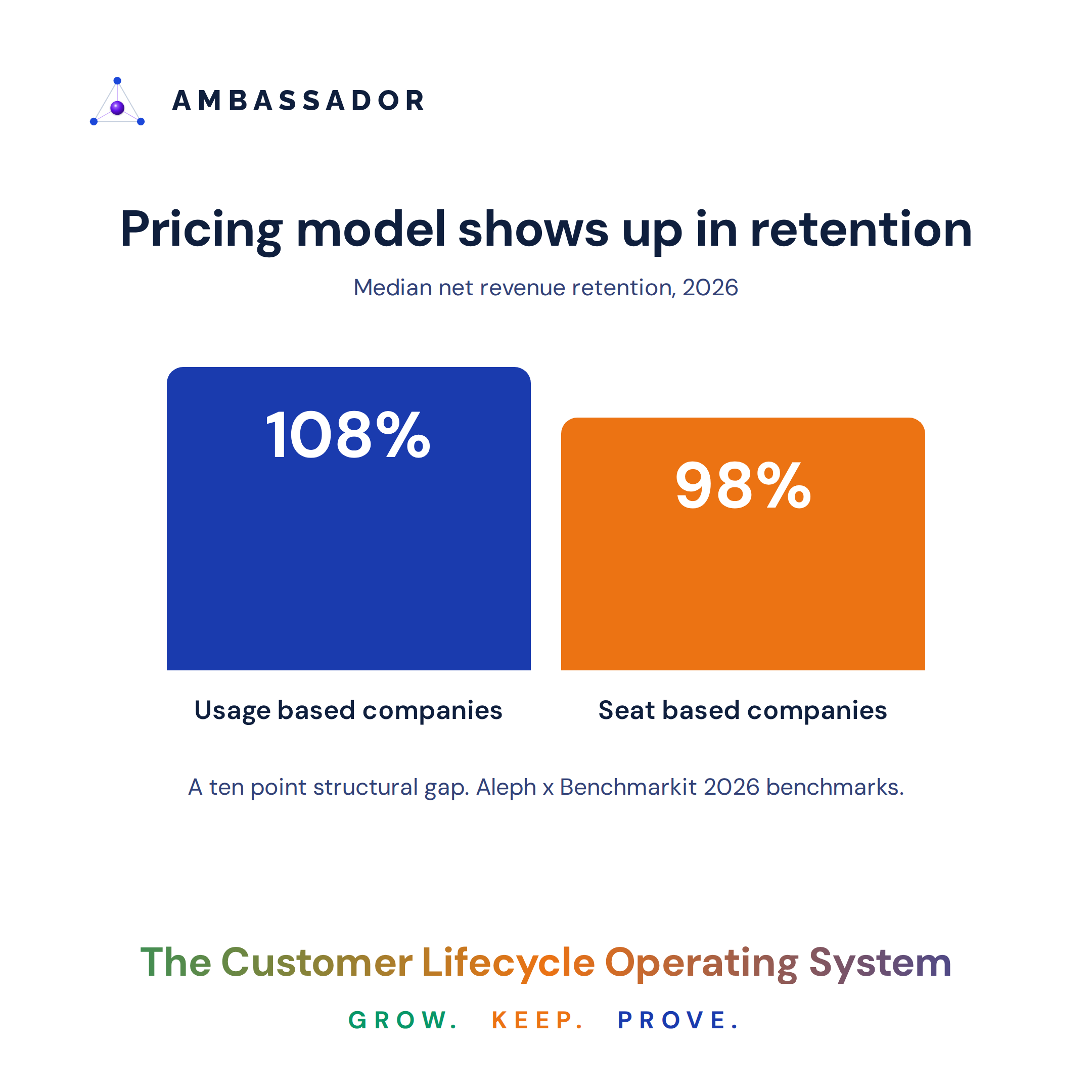
The evidence that this matters is already in the retention data. The 2026 Aleph and Benchmarkit benchmarks found that usage-based companies post a median net revenue retention of 108%, against 98% for seat-based companies. A ten-point structural gap, tied directly to how the software is priced and measured. Intercom's Fin, which charges per resolution rather than per seat, saw new-customer NRR climb from 112% to 146%. You do not reach 146% by raising prices. You reach it by aligning what you charge with what you can prove you delivered, across the entire customer relationship.
What to do about it
The vendors who thrive in this shift will not be the ones with the flashiest agent. They will be the ones who can stand behind a number, end to end, across the whole customer lifecycle.
That is the entire premise behind treating the customer lifecycle as one connected system rather than a pile of disconnected tools. How you grow, through advocacy and acquisition. How you keep, through retention and communication. How you prove it all, through attribution that survives blockers and holds up when the invoice is on the line. When growth, retention, and proof share a spine, the customer stops falling through the gaps, and the number you price on becomes a number you can defend.
The seat was never the value. It was just the thing that was easy to count. What replaces it has to be just as easy to trust.
If a number can be silently blocked, you cannot build a business on it. And in 2026, you increasingly cannot bill on it either.
GROW. KEEP. PROVE.
Sources: Bessemer 2026 AI Pricing Playbook; Gartner (July 1, 2026); Futurum 1H 2026 Enterprise Software survey; Jason Lemkin, SaaStr (Aug 25, 2026); GWI Q2 2025 via Backlinko; IAB U.S. State of Data 2026 (Feb 2026); Salesforce State of Marketing 9th Edition; Aleph x Benchmarkit 2026 SaaS Benchmarks; Intercom/Fin via Mostly Metrics.