Still on Ambassador 2.0? Here's What That's Costing You.
We're going to be direct with you.
If you're still running your program on Ambassador 2.0, you're not just missing features. You're falling behind — and the gap is getting wider every single week.
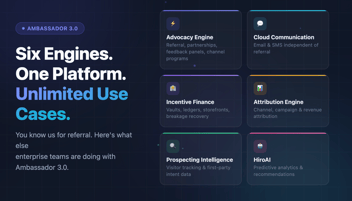
Over the last several months, we've shipped the Incentive Finance Engine, the Cloud Communication Engine, the Attribution Engine, the Prospecting Intelligence Engine, HiroAI, and an entirely rebuilt Advocacy Engine. We've launched Smart URLs, Smart Redirects, automated workflows, SMS, storefronts, vaults, ledgers, breakage recovery, and AI-powered recommendations.
None of it exists on 2.0. Not a single piece of it.
Every week your program runs on 2.0, it runs without channel attribution, without breakage recovery, without the ability to send a single email or SMS natively, without AI telling your team what to do next, and without the finance-grade incentive infrastructure that enterprise teams are already using to manage budgets, automate fulfillment, and recover unredeemed spend.
That's not a feature gap. That's a platform gap. And it's only going in one direction.
What You're Running Without on 2.0
Let's make this concrete. Here's what 2.0 doesn't have — and what teams on 3.0 are already using every day.
No Attribution Engine. You have no visibility into which channels your ambassadors are sharing on, which ones are converting, or which emails and SMS messages are actually driving revenue. You're running a program blind to the data that matters most.
No Incentive Finance Engine. You can't set up separate vaults for different programs. You can't offer a branded storefront where participants choose their own reward. You don't have ledgers, reconciliation, or ERP-ready reporting. And you're writing off every unredeemed gift card instead of recovering up to 95% of that spend.
No Cloud Communication Engine. You can't send emails or SMS directly through Ambassador. Every communication either requires a separate tool or gets buried in your marketing automation platform alongside campaigns that have nothing to do with your program. You have no native lifecycle automations, no behavior-triggered messages, and no reactivation workflows.
No HiroAI. Your team is pulling reports manually, guessing at what's working, and answering the question "how is my program doing?" with spreadsheets instead of AI-powered insights. There's no predictive analytics, no recommendations, and no in-platform analyst telling your team what to do next.
No Prospecting Intelligence Engine. Every visitor who clicks a referral link and lands on your site disappears. You're not capturing IP-level data. You're not building a warm prospect database. You're not feeding intent signals into your sales pipeline. That first-party data — the kind you can't buy from an ad platform — is gone.
No Smart URLs or Smart Redirects. You can't shorten links inside automations. You can't dynamically route users based on device, location, or language. You can't deep-link mobile users directly into your app. You can't track which widget drives the most shares.
This isn't about one missing feature. This is about operating on a platform that stopped being the current version of Ambassador months ago.
The Migration Is Easier Than You Think
We get it. Migration sounds disruptive. That's the number one reason enterprise teams put it off — not because they don't want 3.0, but because they're worried about what the transition looks like.
So let's break it down.
In-app setup takes about two days. The platform configuration in 3.0 — campaigns, segments, settings — is significantly faster than 2.0. Our team has onboarded dozens of enterprise accounts on 3.0, and the in-app work is measured in days, not weeks.
The integration is the variable — and we handle it with you. The biggest factor in migration timelines is your integration: CRM, billing platform, website. For clients on HubSpot, our native 3.0 integration eliminates the need for Tray.io middleware entirely — no more overages, no more broken connectors, no more manual snippet placement. For Salesforce clients, our updated managed package is live and supports the full 3.0 feature set. For API clients, our v3 API is cleaner, better documented, and built to handle the use cases that required workarounds on 2.0.
Your share links don't break. We migrate existing share links as part of the process. Your ambassadors don't lose their links, their history, or their earnings. From their perspective, the program just got better.
We build a migration plan specific to your account. This isn't a one-size-fits-all cutover. We review your current setup, your integration architecture, your campaign structure, and your timeline — and we give you a plan that maps the move step by step. You know exactly what's happening, when, and what your team needs to do (which, in most cases, is very little).
You don't have to migrate everything at once. Some enterprise clients move their referral program first and add additional engines — like Incentive Finance or Cloud Communication — after they're live on 3.0. Others want the full rollout from day one. Either approach works. We flex to what makes sense for your team.
Why 2026 Is the Year
There are three reasons this year specifically matters.
The release velocity isn't slowing down. We shipped the Predictive & Recommendation Engine one week and the Attribution Engine the next. The Incentive Finance Engine, Cloud Communication Engine, and Prospecting Intelligence Engine were all released in the months before that. Every week you wait, the delta between what 2.0 can do and what 3.0 can do gets larger. At some point, you're not just behind on features — you're on a different product entirely.
Your competitors are already on 3.0. We've migrated enterprise accounts across SaaS, fintech, telecom, insurance, and proptech — and many of them came from the same competitive landscape you operate in. The teams that moved early are already running multi-engine programs: referral plus incentive programs, referral plus SMS automation, referral plus AI-powered optimization. That's a compounding advantage, and every quarter they're on 3.0 ahead of you widens the gap.
HiroAI gets smarter the earlier you start. HiroAI learns from your program data. The sooner you're on 3.0, the sooner Hiro starts building context on your specific business — your campaigns, your audience, your performance patterns. Teams that migrate now will have months of AI-powered learning by the time teams that wait finally make the move. That head start doesn't just mean better recommendations today. It means a fundamentally smarter platform by the end of the year.
What the Migration Looks Like, Step by Step
We've done this enough times to have it down to a process. Here's what to expect:
Step 1: Migration Assessment. We review your current 2.0 setup — campaigns, integrations, contact volume, reward structure, and any custom configurations. This usually happens on a single call.
Step 2: Migration Plan. We deliver a written plan that includes what's moving, how the integration changes (if at all), timeline, and what your team is responsible for. For most accounts, your team's lift is minimal.
Step 3: Platform Configuration. Our team sets up your 3.0 environment — campaigns, segments, vaults, automations, and any engine-specific configurations. This is the two-day piece.
Step 4: Integration Cutover. We work with your technical team (or handle it ourselves for native integrations like HubSpot and Salesforce) to connect 3.0 to your stack. Share links are migrated. Data is carried over. For native integration clients, this is often the simplest step.
Step 5: Validation and Launch. We test everything end-to-end, validate that referrals are tracking, rewards are processing, and automations are firing. Then we go live.
Most enterprise migrations are completed in two to four weeks. The platform setup is fast — the timeline is almost entirely determined by integration complexity and your team's availability.
What Happens After You Migrate
This is the part people don't expect. Migrating to 3.0 isn't just about keeping up — it's about unlocking things you couldn't do before.
Within the first month of 3.0, most enterprise clients:
- Turn on at least one additional engine beyond referral — usually Incentive Finance (storefronts + vaults) or Cloud Communication (email + SMS automation)
- See the immediate finance impact from breakage recovery and deferred fund pull on gift card rewards
- Start using HiroAI for performance insights instead of manual reporting
- Simplify their integration by moving off middleware like Tray.io and onto native connectors
- Reduce support escalations because 3.0 eliminates many of the technical issues that plagued 2.0 — broken snippets, manual conversion tracking, and legacy configuration gaps
The teams that migrate don't look back. They look around and realize they have a completely different platform than what they were running before — and they start building programs they couldn't have imagined on 2.0.
Ready to Move?
If you've been thinking about it, this is the moment. The platform is ready. The migration process is proven. And every week you wait is a week your program runs without the tools your competitors are already using.
You came to Ambassador for referral. You stayed because it works. Now it's time to see what else it can do.
The only thing 2.0 has that 3.0 doesn't is a reason to switch.