-By Geoff McDonald, CEO, Ambassador
Most teams can draw their funnel from memory. Almost none can tell you where it leaks, in dollars, this quarter. That gap is what this framework exists to close.
Here is the whole thing in one block, so you can steal it before I explain it:
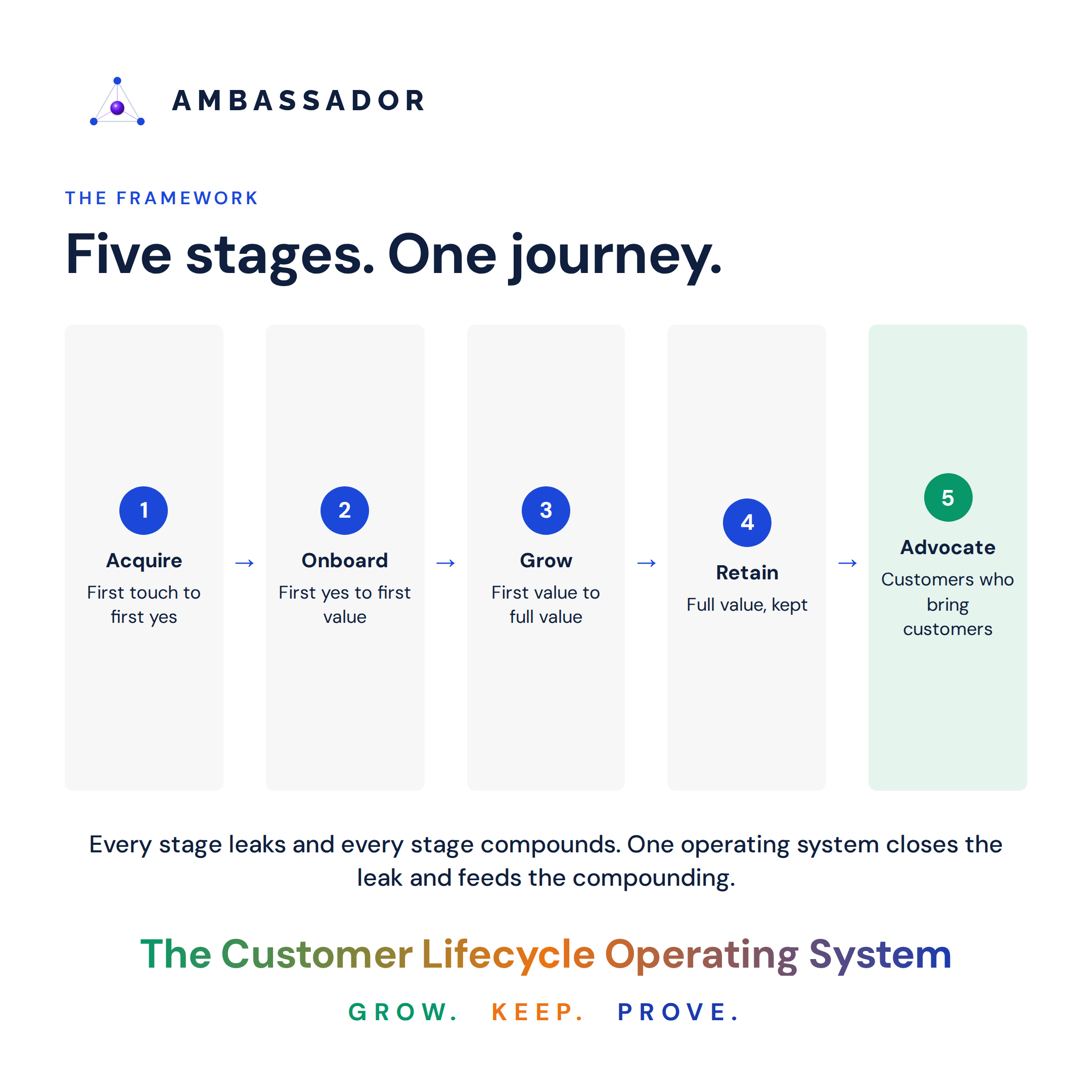
- Five stages: Acquire, Onboard, Grow, Retain, Advocate. Every customer moves through all five, whether or not anyone is watching.
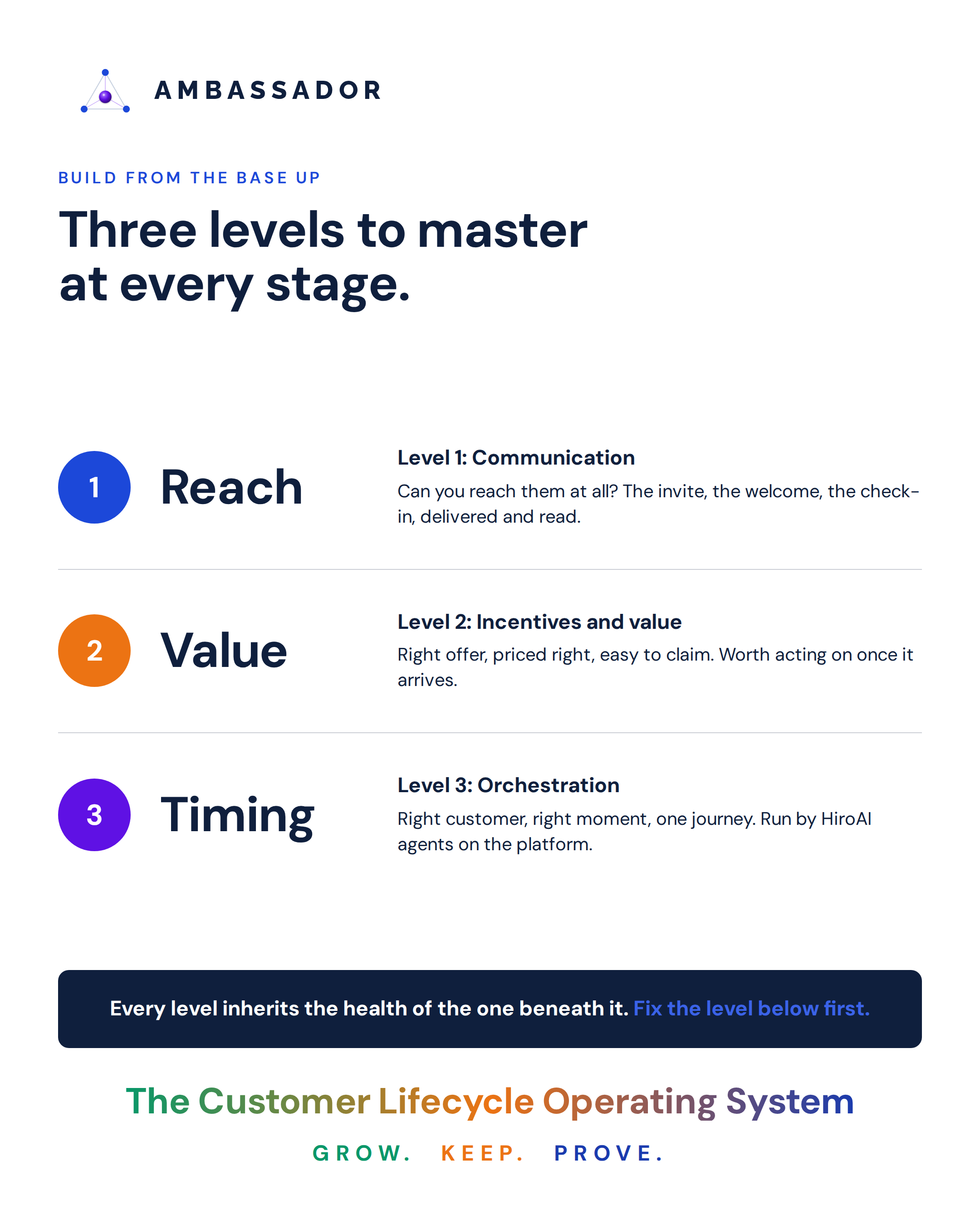
- Three levels at every stage: Level 1 is Communication (can you reach them at all?). Level 2 is Incentives and value (right offer, priced right, easy to claim). Level 3 is Orchestration (right customer, right moment, one journey).
- One rule: fix the level below first. Orchestration cannot save an offer nobody wants, and an offer cannot save a message nobody receives.
- One measure: dollars of leak closed.
Signals in, proof out. That is the entire operating model. Now let me show you why the grid matters more than any single tool you will buy this year.
First, the part everyone skips
Every company already runs all five stages. You acquire customers, you onboard them, you grow them, you try to keep them, and a few of them talk about you. The question was never whether the lifecycle exists. The question is whether anyone owns it end to end.
In most companies, nobody does. Acquisition belongs to marketing. Onboarding belongs to CS. Expansion belongs to sales. Retention belongs to whoever noticed the churn number last. Advocacy belongs to no one, which is why your happiest customers are usually the least asked.
So when you lay the five stages across the top and the three levels down the side, you get a fifteen-cell grid, and every cell has exactly two things in it: a value leak and a value opportunity. The grid is not a maturity model. It is a leak map.
The three levels, from the base up
The levels matter because they stack. Each one inherits the health of the one beneath it.
Level 1: Communication. Can you reach them at all? The referral invite that reaches the inbox. The welcome email that actually arrives. The upgrade message that lands and gets read. The check-in that reaches a customer before they drift. The thank-you that shows up right after a win. None of this is glamorous, and all of it is diagnosable from an export, which is why it is the quick win.
Level 2: Incentives and value. Once the message arrives, is the offer worth acting on? A reward too small to share is a leak. A first-use bonus that drives activation is an opportunity. Discounting customers who were going to upgrade anyway is a leak you pay for twice. A save offer matched to the real reason someone is leaving is the difference between a coupon and a rescue.
Level 3: Orchestration. Right customer, right moment, one journey. The referral ask timed right after a win instead of blasted on a calendar. The nudge that catches setup stalling past day seven. The win-back that goes out before they have gone, not after. This is the level where HiroAI and its agents do the work humans cannot do at scale: read the signals, diagnose the cell, prescribe the move, run it, measure it, learn.
The rule bears repeating because it is the one teams break most often: fix the level below first. I have watched companies buy journey orchestration while their welcome email bounced. That is a sequencing failure, not a technology one.
What the market data says about where you actually are
Two numbers tell you why the leaks are structural, not accidental.
First, utilization. A Gartner survey of 405 marketing leaders found that organizations were using just 33 percent of their martech stack's capability on average in 2023, down from 42 percent the year before and 58 percent in 2020, even as technology consumed roughly a quarter of the marketing budget. Gartner's respondents pointed at ecosystem complexity, customer data challenges, and governance as the main blockers. Read that against the grid: the tools exist for almost every cell, but the stack is fragmented across owners, so utilization falls and the leaks stay open.
Second, the prize. Bain & Company's long-standing research finding holds that a 5 percent improvement in customer retention can lift profits by 25 to 95 percent, because retained customers cost less to serve, buy more over time, and refer the next cohort. The Retain and Advocate columns are where that compounding lives, and they are exactly the columns most teams staff last.
Put those together and the strategy writes itself. You do not need more cells covered by more tools. You need the cells you already have wired into one system that measures the leak and closes it.
The leak audit: one example per stage
You can run a first pass on this in an afternoon. Pick one leak per stage, confirm it against your own data, and price it.
- Acquire, Level 1: the referral invite never reaches the inbox. Count invites sent versus delivered. Every missing delivery is pipeline you already paid for.
- Onboard, Level 1: the welcome email never arrives, or setup stalls past day seven with no nudge. Cohort your activations by day and look for the cliff.
- Grow, Level 2: you are discounting would-be upgraders. Pull last quarter's upgrade list and check how many got a promo they never needed.
- Retain, Level 3: the win-back sends after the customer has already gone. Compare send timestamps against cancellation dates. The order of those two events is the whole diagnosis.
- Advocate, Level 2: the thank-you reward sits unspent. Unredeemed rewards are enthusiasm you generated and then wasted.
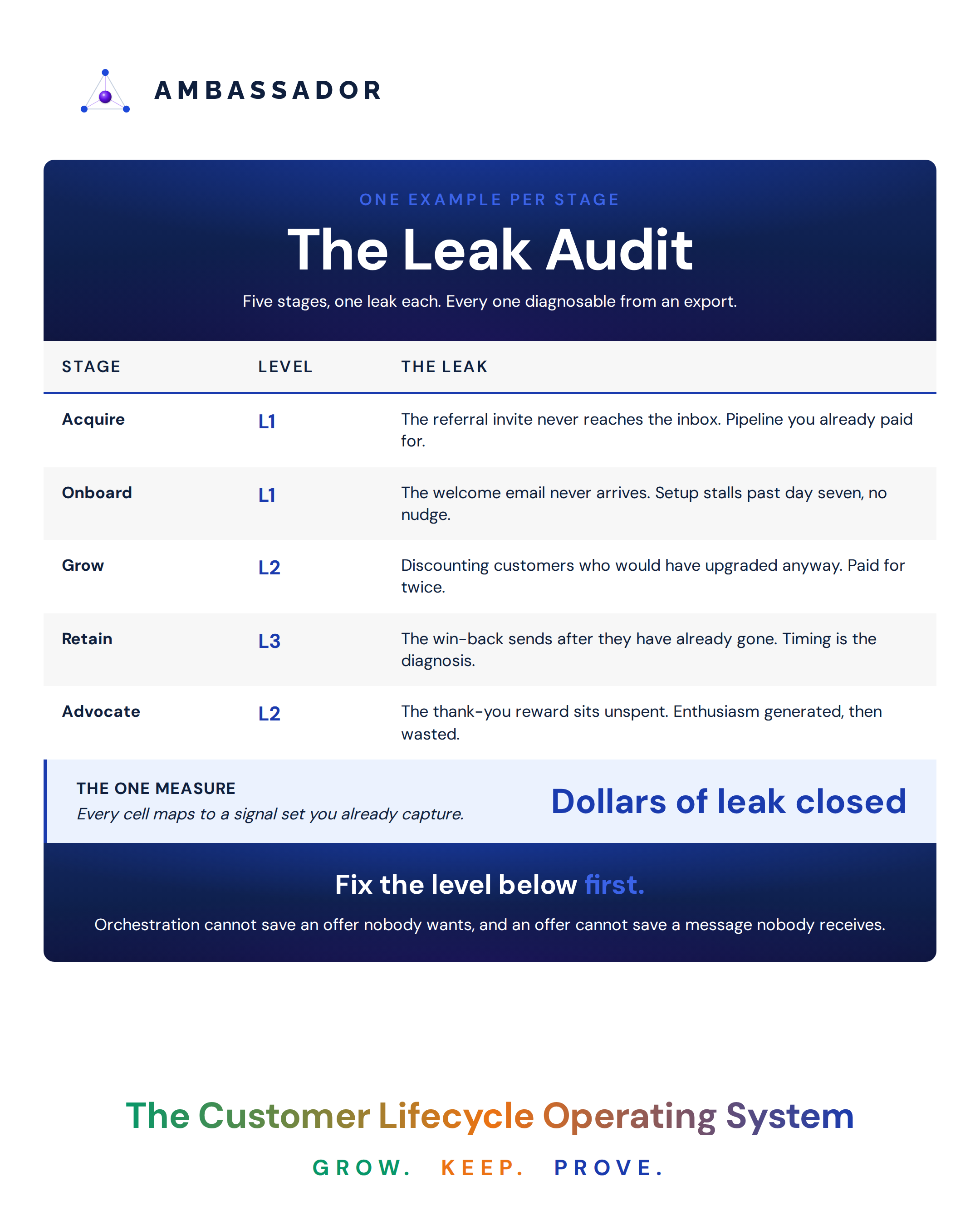
Each of these maps to a signal set your systems already capture: CRM, billing, product, support, surveys. That is the foundation layer of the whole framework. You are not instrumenting anything new. You are finally reading what you already collect.
Signals in, proof out
The last discipline is the one that makes the rest defensible: proof, measured and attributed at every level. Not a dashboard of activity. Attribution of outcomes to the moves that caused them, so the leak audit turns into a ledger.
This is where we have placed our own bet. Across the programs we can attribute cleanly, we have tracked $2.4B+ in revenue attributed to date, and we hold programs to a 3:1 floor, with the best running 5:1 or better. I wrote up the full architecture behind that bet in an earlier post on the whole bet, and you can see how the pieces fit on the platform overview. The short version: one operating system across all fifteen cells beats fifteen point solutions with fifteen owners, because the learning compounds in one place.
Where to start this quarter
Do not start with Level 3. Start at the base.
- Run the Level 1 audit above. It is diagnosable from exports you can pull today.
- Price the two biggest leaks in dollars. Not percentages. Dollars make the fix fundable.
- Fix those two, measure the close, then and only then move one level up.
Five stages. Three levels. One operating system. The companies that win the next five years will not be the ones with the most tools. They will be the ones who can open the grid, point at any cell, and say what it leaked, what they fixed, and what that was worth.
Grow. Keep. Prove.
Ambassador is The Customer Lifecycle Operating System, orchestrated by HiroAI. The fifteen-cell grid above is the map our platform runs, from the first invite to the attributed dollar. See how it works.