-Geoff McDonald (CEO)
I have had a run of new prospect conversations over the last few weeks, and two of them ended in exactly the same place.
Both companies had launched a referral program. Both had gotten a real lift out of it, the kind that becomes a leadership talking point inside a month. Both had then watched the line flatten. And both were sitting across from me trying to work out whether the fix was a better incentive, more internal promotion, or a different vendor.
I have heard that conversation before. We heard it constantly on Ambassador 2.0, from clients who had done everything right and could not understand why the good quarter would not repeat.
What is different now is where I am hearing it. It is not just our own base anymore. It is the market. And the people saying it are not asking for a feature. They are trying to work out how customer-led growth is supposed to function from here, because the way they have been sold it for the last fifteen years has stopped producing.
That is the reason 3.0 exists, and it is the reason we keep building inside it every week. Not because referral needed better plumbing. Because what companies actually need is a path from a point solution to an operating system, and nobody was building the path.
So let me lay out the argument properly, because it is the same argument in every one of those conversations.
The spike is not the achievement. It is the proof.
Advocacy is the right first move, and it is the right first move for boring, defensible reasons.
Referred revenue carries a lower cost of acquisition than any paid channel you run. Referred customers close faster and churn less, because they arrived with a warm recommendation instead of an ad impression. And unlike almost every other growth lever, advocacy gets cheaper as it gets bigger, because the people producing it are already in your base.
So the first program works. That is not luck and it is not the vendor. That is the channel behaving the way the channel behaves.
The mistake is treating the spike as the outcome rather than as evidence. What the spike actually proves is that your customers, or your employees, or your partners will refer you when asked. That is an extremely valuable thing to have proven. It is also, on its own, worth exactly one audience.
Why it flattens
Here is the part almost nobody diagnoses correctly, including both companies I sat with.
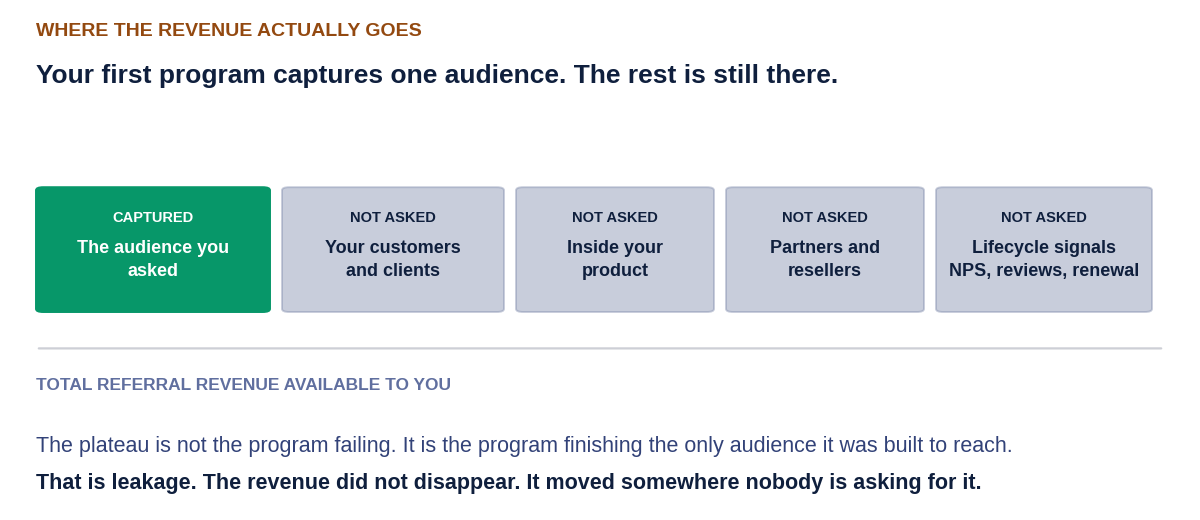
The plateau is not the program failing. The plateau is the program finishing.
Whatever audience you pointed the program at is finite. If you asked your employees, there is a fixed number of employees and a fixed share of them who will ever participate. If you asked your best customers, same story. Once everyone who will refer you has referred you, the curve does what a saturated curve does. It flattens.
The revenue did not disappear. It moved.
It moved to your customers, who were never asked. It moved into your product, where the moment of highest enthusiasm passes without anyone capturing it. It moved to your partners and resellers, who have every reason to send you business and no mechanism to do it. And it moved into your lifecycle signals, where someone gives you a nine out of ten on a survey and nothing happens next.
We call that leakage. It is the single most expensive thing in customer growth, because it is invisible. Nothing shows up as a loss. There is no failed campaign to review. There is just a flat line, and a program owner being asked why the good quarter did not repeat.
Three failures, not one
When we sit with companies at the plateau, the same three structural problems show up almost every time. They are not program problems. They are architecture problems, which is why changing the incentive never fixes them.
The audience runs out. Covered above. This one is arithmetic, not strategy.
The data stops at the tool. A referral tool captures a referral and hands off a lead. The trail ends there. Advocacy sits in its own silo, retention sits in another, surveys and reviews in a third, paid media in a fourth. Nothing shares a customer record. Which means that even when the program is working, nobody can walk into a board meeting and show what it returned without assembling the answer by hand first. Reward eligibility gets rebuilt monthly out of CRM reports. Attribution is a spreadsheet exercise.
Each next move costs another vendor. Want a rewards storefront? That is a vendor. A leaderboard and participant dashboard? Often a second one. Surveys and NPS? A third. A client-facing program alongside the internal one? Frequently a fourth contract with a fourth integration. Every one of them lands in the same program owner's budget, and that line grows every single year the program succeeds. The cost curve outruns the revenue curve.
This is the shape of the trap, and it is worth being precise about it. The problem is not that point solutions are bad software. Several of them are very good software, and I will say that in a competitive deal. The problem is that the pricing unit and the data model are both scoped to one program, so scaling the outcome scales the bill and never scales the intelligence.
The curve
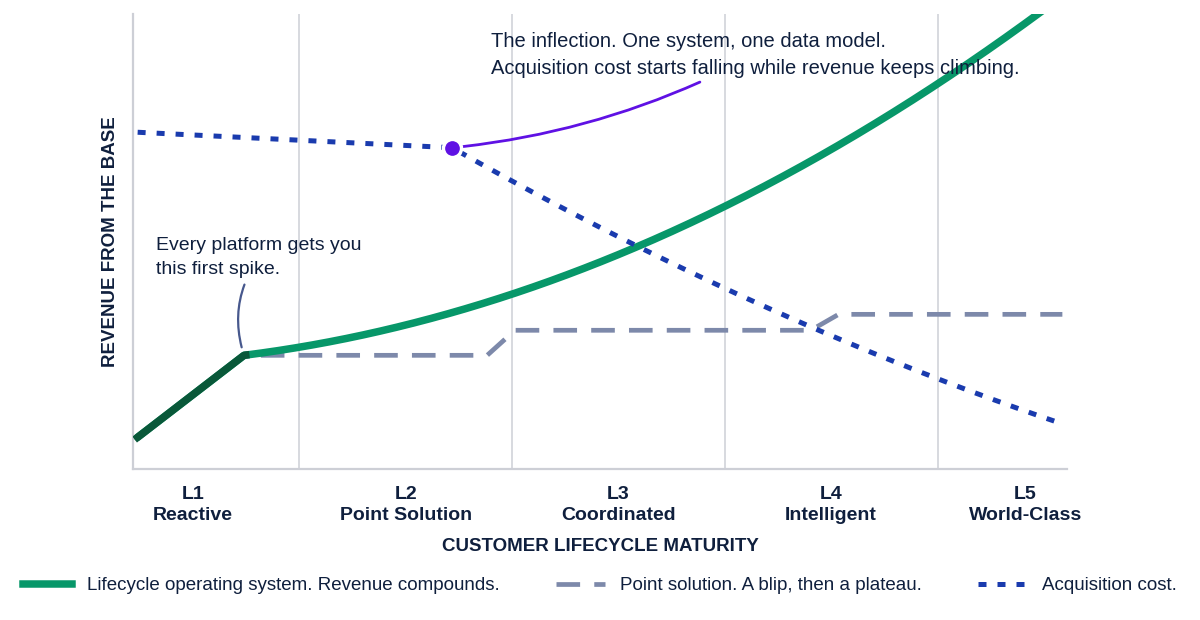
Put the two paths on the same axes and the argument stops being philosophical. This is the chart I end up drawing on a whiteboard in most of these conversations.
The horizontal axis is lifecycle maturity, running from L1, where referrals happen by accident, to L5, where every advocacy motion is attributed and orchestrated. The vertical axis is revenue from the customer base you already own. The dotted line is your cost of acquisition.
Notice the first thing that matters: both paths share the same opening spike. Every platform gets you that. Anyone selling you a referral tool will get you that, and if that is all you need, buy the cheapest one that does it well.
Then the paths separate. The point solution path does what point solutions do, which is a blip, a plateau, another blip when you add a feature, another plateau. Each blip is real. None of them compound, because each one is a separate system with a separate data model.
The other path keeps climbing, because each new audience and each new signal makes the previous ones more productive. The customer who was referred last quarter becomes a referrer this quarter. The strong survey score becomes a referral invitation the same day. The person who shared a link and never finished gets followed instead of forgotten.
And around L3, something happens to the dotted line. Acquisition cost, which has been drifting sideways, breaks downward. That is the inflection, and it is the whole reason this argument matters to a CFO rather than just to a program owner.
Why the second audience only works on one system
You can, in theory, buy a second point solution for the second audience. Plenty of companies do. It does not produce the compounding curve, and the reason is mechanical rather than ideological.
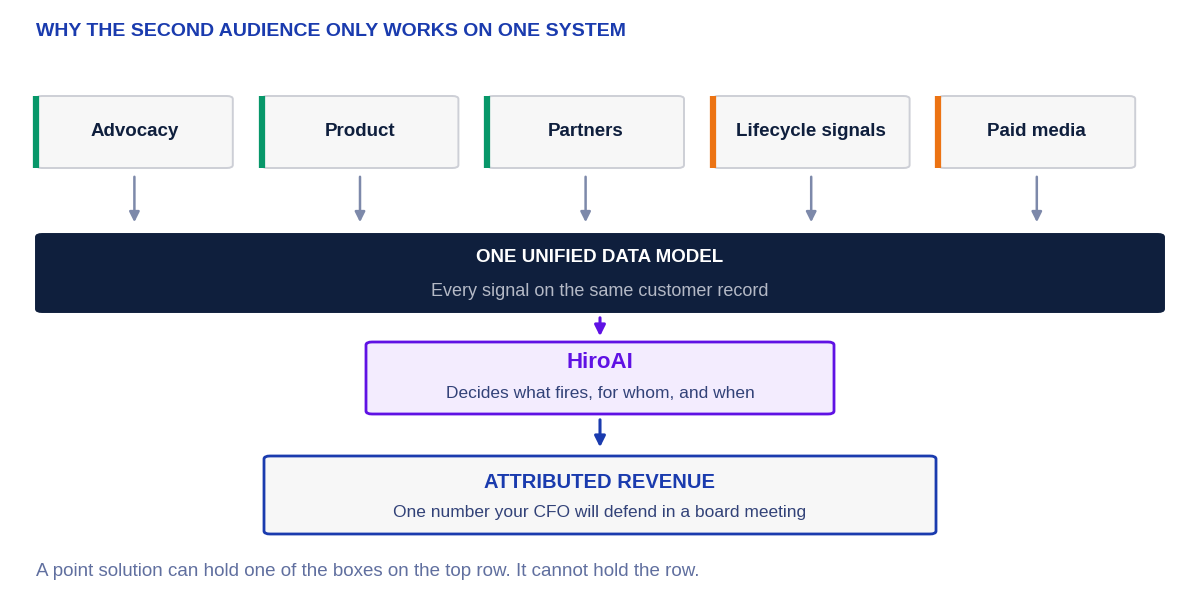
Advocacy, product, partners, lifecycle signals, and paid media each generate signals about the same human being. If those signals live in five systems, you have five partial pictures and no way to act on the whole. You cannot trigger a referral invitation off a survey response if the survey tool and the referral tool do not share a customer record. You cannot retarget someone mid-referral if your paid media platform has never heard of your referral funnel. You cannot tell your CFO what any of it returned, because attribution requires a single spine.
One unified data model puts every signal on the same record. An orchestrator sitting above it decides what fires, for whom, and when. And because every action and every dollar traces back through one system, the output is a number your CFO will actually defend rather than a number your CFO tolerates.
A point solution can hold one of those boxes very well. It cannot hold the row.
This is the part that took us the longest to build, and it is the part that has nothing to do with referral features. It is a data model and an orchestration layer. Everything else sits on top of it.
The compounding equation
Growth leaders get asked two questions in every budget cycle. Is this producing revenue, and is it producing revenue efficiently. Most customer program spend can answer the first and not the second.
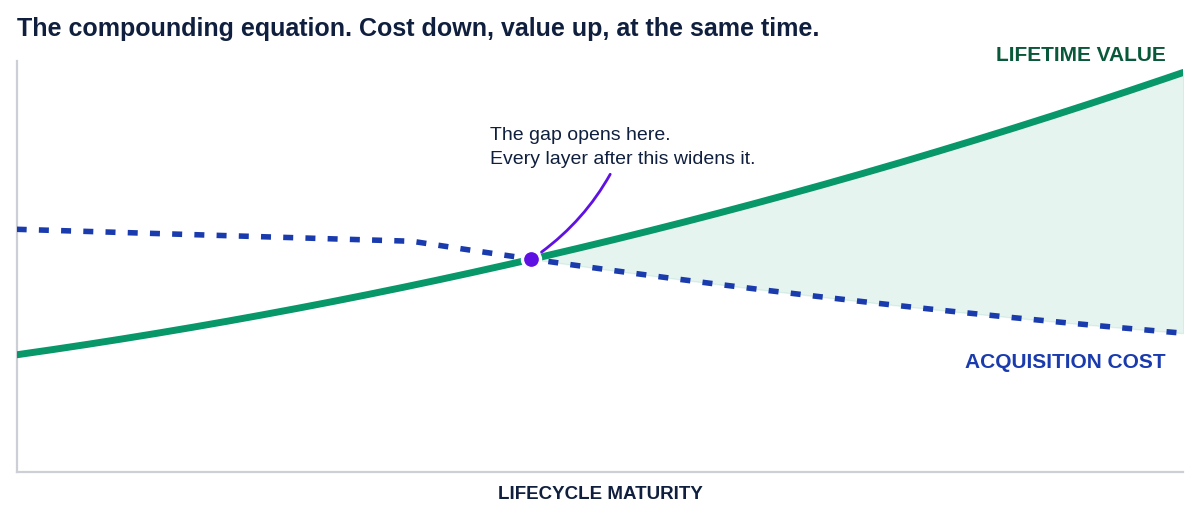
What happens across the maturity curve is that lifetime value climbs while acquisition cost falls, at the same time, for the same reason. Every additional advocacy audience is cheaper to activate than the last, because the infrastructure is already in place and the intelligence is already accumulated. Every additional lifecycle signal makes targeting more precise, which raises conversion, which lowers cost per acquisition again.
That gap between the two lines is the entire business case. It does not open at the first spike. It opens at the inflection, and every layer after it widens it.
The path, which is not a big bang
None of this argues for buying a whole lifecycle on day one. It argues against it, and I say that in sales conversations against my own short-term interest.
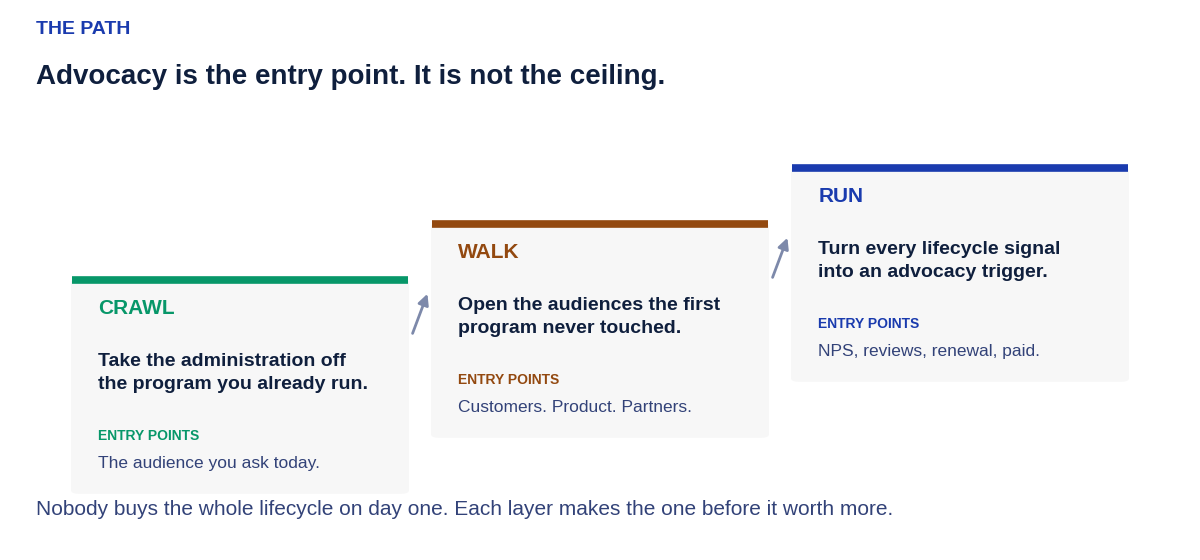
Crawl. Take the administration off the program you already run. Same audience, same structure, none of the manual work. Rewards fire on the CRM stage you choose instead of on a monthly report. Every participant gets a live leaderboard and a personal dashboard. Entry is a link or a QR code with no login, because every login you require is participation you lose. Payouts reconcile and ledger themselves before finance ever sees them.
The goal at crawl is not new revenue. It is getting the existing program to run without a person holding it together, so the next step is possible at all.
Walk. Open an audience the first program never touched. Your customers, if you started internally. Your product surface, if you started with people. Your partners, if you started with customers. Let them feed each other. This is where the curve resumes climbing, and it is usually the cheapest incremental revenue available to the business.
Run. Turn every lifecycle signal into an advocacy trigger. Surveys, NPS, reviews, renewals, and retention events all become moments where an ask is timed to enthusiasm rather than to a campaign calendar. Programmatic follows the people already inside your referral funnel who have not finished. Attribution ties every dollar back to the signal that started it.
Each layer makes the one before it worth more. That is the definition of compounding, and it is the thing a stack of point solutions structurally cannot do.
The argument that actually wins the budget
One more thing, and it is the part that tends to decide these conversations at the executive level.
A point solution puts the entire cost inside one program owner's budget, and grows that line every year the program works. It is a strange kind of punishment for success, and every program owner who has been through a renewal cycle recognizes it.
An operating system spreads the same spend across marketing, sales, retention, and product, because each of those functions gets something out of it. Marketing gets acquisition. Sales gets pipeline. Retention gets save motions and reward infrastructure. Product gets in-product growth surfaces.
Same revenue. Diversified operating expense. That is a materially easier number to defend, and it is usually the reason a conversation that started with a program manager ends up in front of a CRO.
Where are you on the curve
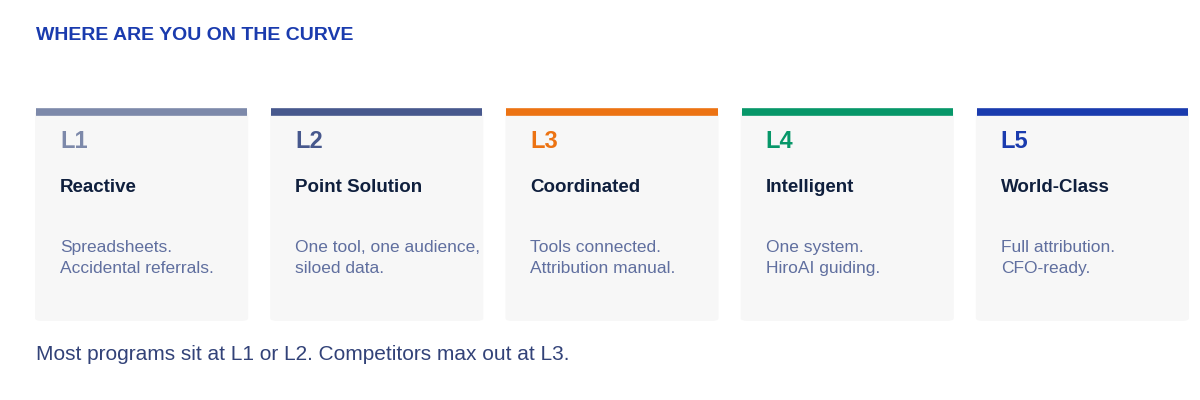
Most programs sit at L1 or L2. That is not a criticism. Almost every company is siloed today, because the tooling has been sold that way for fifteen years. Competitors in this category max out at L3, where tools are connected but attribution is still manual.
Three questions worth answering before you talk to any vendor, including us.
What did your last program lift, and has it flattened? If it is still climbing, you are early and you should keep going. If it flattened, you have already found your first audience's edge.
Which audiences could refer you and are not being asked? Write them down. Customers, employees, partners, in-product users, high-scoring survey respondents. The list is almost always longer than the program.
Can you attribute any of it to revenue? Not activity. Revenue. If the answer requires someone to build a spreadsheet, you have a data model problem, not a reporting problem.
If you answered flattened, more than two, and no, you are exactly where both of those prospect conversations started.
Why this matters more than it did three years ago
I want to be direct about why I am writing this now instead of two years ago.
Acquisition is getting more expensive and less predictable at the same time. Paid channels are saturating. Search behaviour is moving to AI assistants that do not send you the same traffic. Cookie-based targeting keeps degrading. Every quarter, the share of growth a brand can buy gets smaller and the share it has to earn from the customers it already has gets bigger.
Which means the base stops being a retention concern and becomes the primary growth channel. And a primary growth channel cannot run on a point solution with a siloed data model and manual attribution. It needs infrastructure, the same way ecommerce needed a platform instead of a shopping cart plugin.
That is the wave. Brands that treat customer-led growth as a program will keep getting one spike at a time. Brands that treat it as infrastructure will compound. I do not think that gap stays survivable for very long.
Go deeper
We put the full argument, including the maturity model in detail and the economics behind the inflection, into two longer pieces.
- The Advocacy Plateau: a whitepaper on lifecycle maturity and the economics of compounding customer revenue
- Advocacy is the entry point, not the ceiling: the presentation version
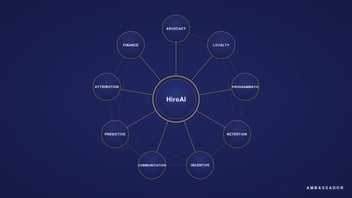
Ambassador is The Customer Lifecycle Operating System. One system that keeps advocacy running and reaches everywhere else it should be firing, orchestrated by HiroAI. One orchestrator, nine engines, seven specialist agents.
If your program flattened and you want to know where you actually sit on this curve, that is a 45 minute conversation, not a demo. Book a strategy session.
Geoff McDonald CEO and Co-Founder, Ambassador
Forward-looking capabilities named here, including Surveys, NPS, Reviews, Programmatic Audiences, and AI Agents, are planned and subject to availability and then-current terms.