-Geoff McDonald, CEO of Ambassador
Meta description: Enterprise leaders told us where customer value is leaking. Here is the framework we built in response, and where to start. Download the white paper.
Over the past year, we have spent a great deal of time with growth, retention, and finance leaders at large telco and financial services companies. The conversations began in different places. They kept arriving at the same problem.
Customers are leaving, or spending less, for reasons that are hard to see from the top of the business. Leaders know the total is missing its target. What they cannot see is which small leaks, spread across the customer lifecycle, are adding up to the miss.
We heard you. Our new white paper, Close the Leaks, shares what those leaders told us, the framework we built in response, and how enterprises are starting to close those leaks quickly.
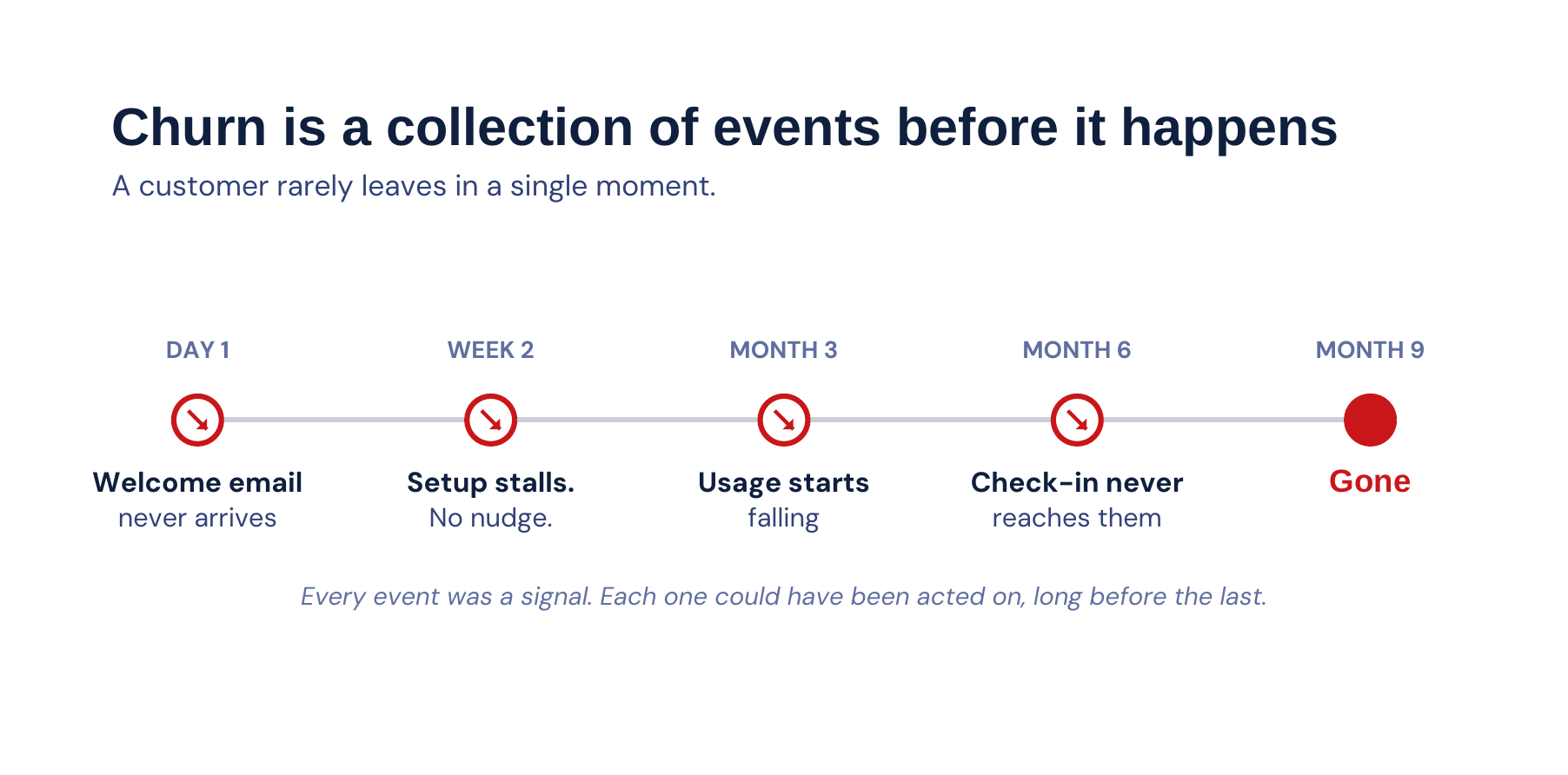
Churn is a collection of events before it happens
A customer rarely leaves in a single moment. The welcome email never arrives. Setup stalls in the second week, and nobody notices. Usage starts to fall. The check-in never reaches them. By month nine, they are gone.
Each of those moments was a signal: a customer behaviour, captured by a system the company already runs, that showed value was about to be lost. The problem is not a lack of data. It is that the signals are spread across systems and never acted on.
Retention is now the business
From around 2011, low interest rates and easy capital rewarded companies for winning market share at almost any cost. Existing customers were often treated as a cost to manage rather than the business to grow.
That era is over. Capital is more expensive, and the cheapest revenue most companies have is the customers they already paid to win. In PwC’s 2025 Customer Experience Survey, 89% of executives said customer loyalty had grown. Only 39% of consumers agreed. That gap is where value leaks.
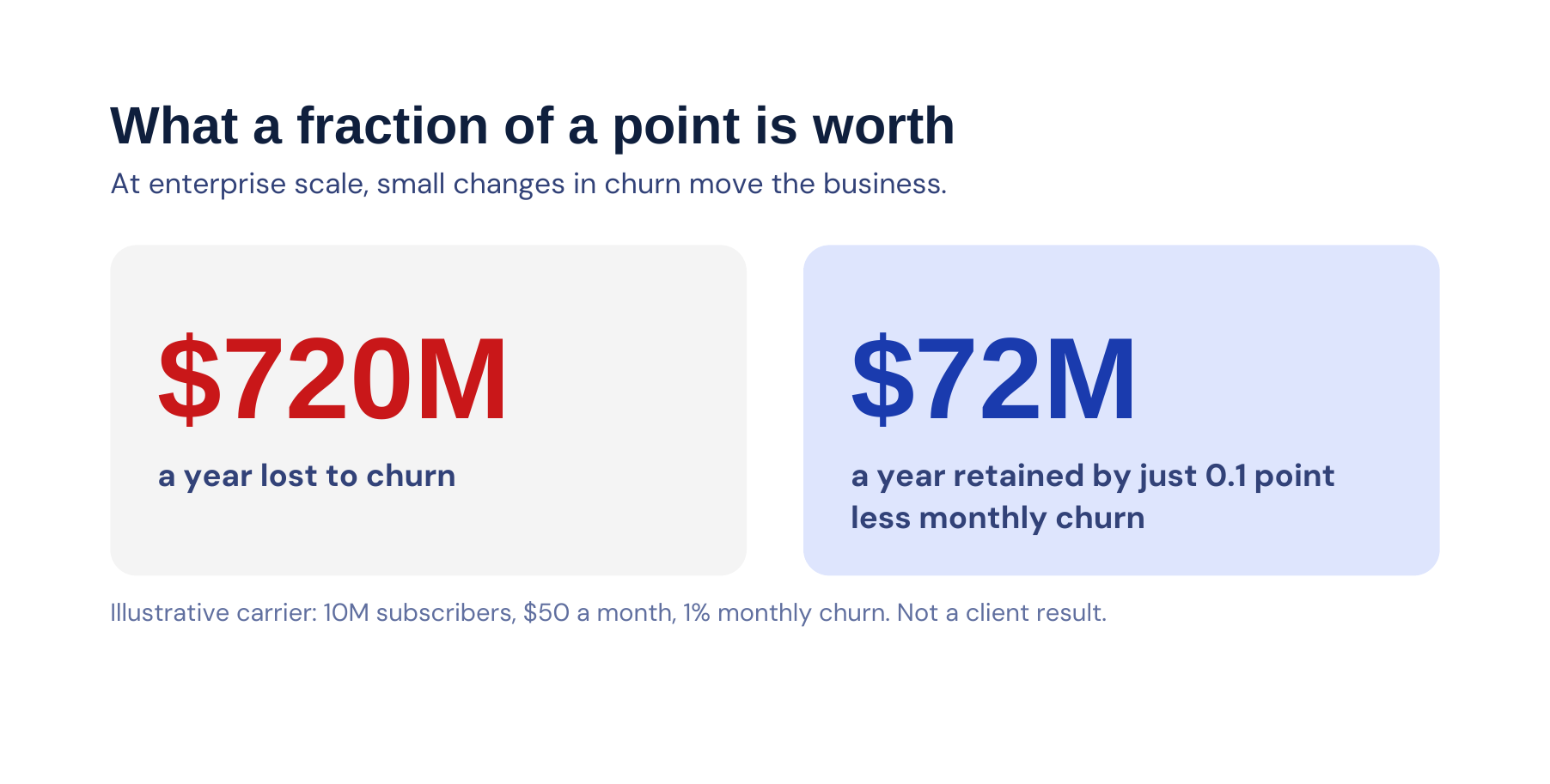
The scale is easy to underestimate. An illustrative carrier with 10 million subscribers at $50 a month and 1% monthly churn loses roughly $720 million a year. Lowering that churn by just 0.1 point a month is worth about $72 million a year. At enterprise scale, a fraction of a point moves the business.
Five stages, three levels
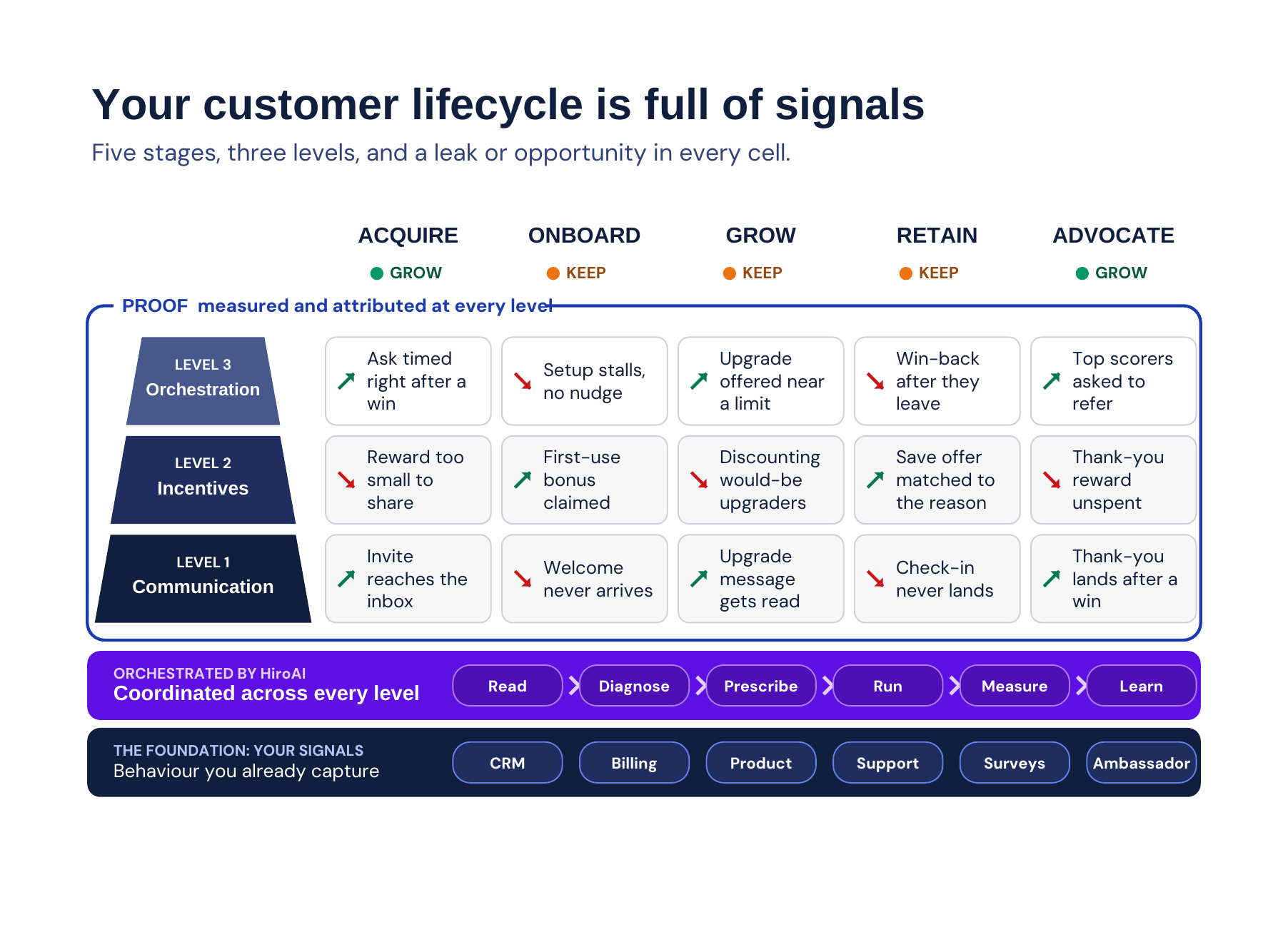
The Customer Lifecycle Operating System looks at the lifecycle in five stages: Acquire, Onboard, Grow, Retain, and Advocate. Each stage has three levels to get right, built from the base up:
- Communication. Can you reach the customer at all?
- Incentives. Are you offering the right thing, and does it get claimed?
- Orchestration. The right customer, at the right moment, as one journey.
Signals sit underneath everything, and results are measured at every level. Reviewing each cell reveals specific leaks to close and opportunities to capture. When automation runs consistently across the whole lifecycle, with your team setting direction, the result is an autonomous Lifecycle OS.
Start with communication
If a message never reaches the customer, nothing that follows can work. A bill that never arrives or a renewal notice in the spam folder is a customer who never got the chance to stay. Most brands do not know how much of their messaging never lands.
One financial services company came to us asking for more referrals. A review of their email found that only about 10% of one list was reaching the inbox, because of trigger words under new mailbox-provider rules. After the fixes, about 98% landed. That single finding was worth more than another campaign.
Start small. Prove it. Then scale.
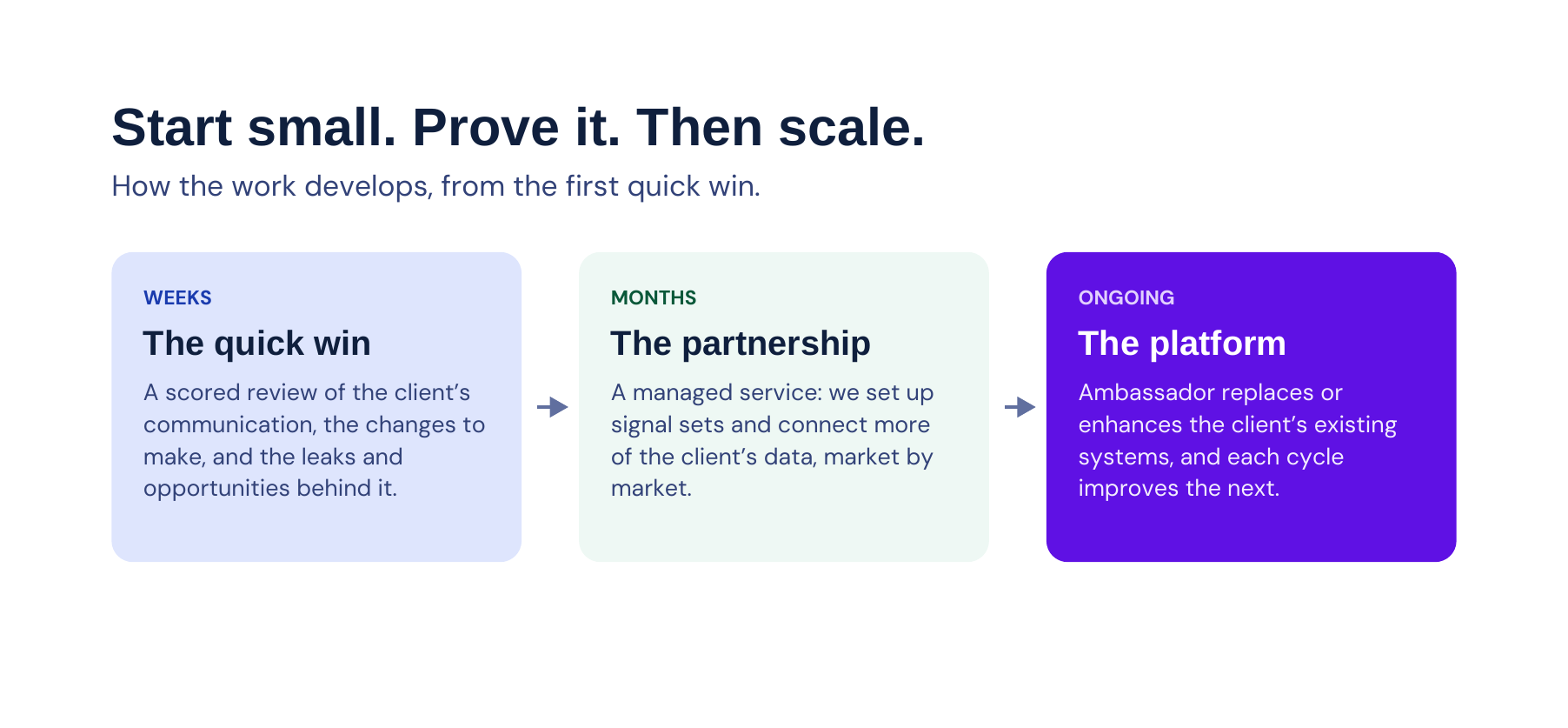
The leaders making real progress are not trying to fix everything at once. They told us three things. They want a partner, not another platform to learn. They want substance, not hype. And they want to crawl, walk, and run.
So the work starts with a focused review of communication that our team runs on our platform. From there, it extends into incentives and orchestration, market by market and source by source. Some teams run their programs on Ambassador. Others connect their existing systems, so Ambassador makes them more effective. People stay in the loop throughout, approving what reaches customers.
Why outcome data changes the picture
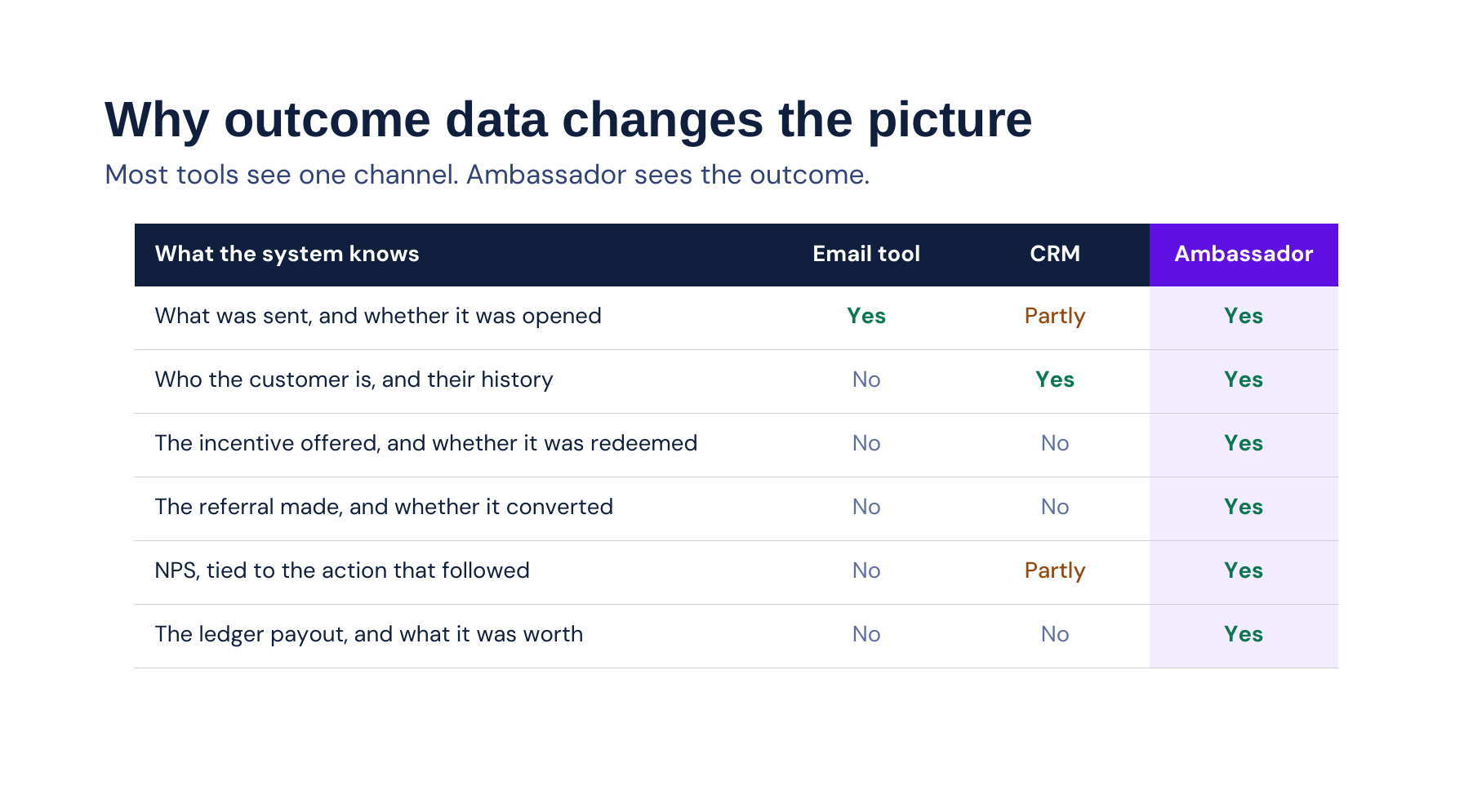
Any automated system is only as good as the information it acts on. Email tools know what was sent and opened. CRMs know who the customer is. Neither sees the outcome: the incentive redeemed, the referral converted, the NPS tied to what happened next, the payout and what it was worth. Because Ambassador designs, delivers, and pays out the incentive, it sees the outcome of each action, and each program improves on the last.
Read the full paper
Close the Leaks covers:
- What enterprise leaders told us, in five themes
- Why the market has moved from the acquisition era to the retention era
- The full Customer Lifecycle Operating System framework
- Where to start, and how the work develops over time
- Why outcome data changes what your systems can do
- A simple worksheet to estimate the revenue at risk in your own business