By Geoff McDonald, CEO, Ambassador
This year I noticed I had stopped talking to the same people. For a long time, the person across the table from us was a program manager with a clear, reasonable ask. Show me twenty more referrals a month. Get my reward program live before the quarter closes. Good conversations, and small ones.
Now the chair is taken by a CEO, a CFO, or a division head, and the question has a different shape. Customers are leaving out the back, costs keep climbing, and nobody can say why. Go fix it. One CFO's office told us the company runs seven separate platforms and wants to get down to one or two, and to automate the work without adding headcount.
That shift is the reason for this post. The buyer moved up, and the question moved up with them, from how do I run a program to where is my profit going. Here is how I think about answering it, and why I think most of the answers on offer miss.
First, what the executive in the room is actually asking
Executives like what AI makes possible, and they are tired of paying people to do routine work a system should handle. But they sign for a goal, and right now that goal is profit. AI is how the work gets done.
The levers behind it are the same three every time. How much each customer pays, which is ARPU. How many leave, which is churn. And how many stay but shrink, which is contraction. Every conversation I have been in this year comes back to one of those three.
If you sell into that conversation by leading with your technology, you earn a meeting. If you lead with the number the executive already owns, you earn the second meeting, and the third.
Second, why profit is a different conversation than growth
Growth and profit sound like cousins, yet new revenue arrives with a cost to win it, a gross margin that never reaches 100%, and a pile of friction that comes with every new customer. Removing a cost works differently. It is immediate, it stays removed, and every dollar of it drops to the bottom line.
Retention works the same way, and the math gets uncomfortable quickly. Take a carrier with 10 million subscribers paying $50 a month, and suppose 1% of the starting base leaves each month. After twelve months that is about 1.2 million subscribers gone and roughly $720 million in annual revenue walking out with them. I picked round numbers, so treat it as an illustration. Then put your own numbers in and see how long it takes to get uncomfortable.
In businesses that spend heavily to win a customer and run on thin margins, telecom and financial services most of all, that math is the business. A small improvement in how many customers stay is large in dollars, and it does not need anyone to win a new logo.
Third, why leadership cannot see it
Here is the part that has bothered me the longest. The people with the most at stake are often the least able to see the leak.
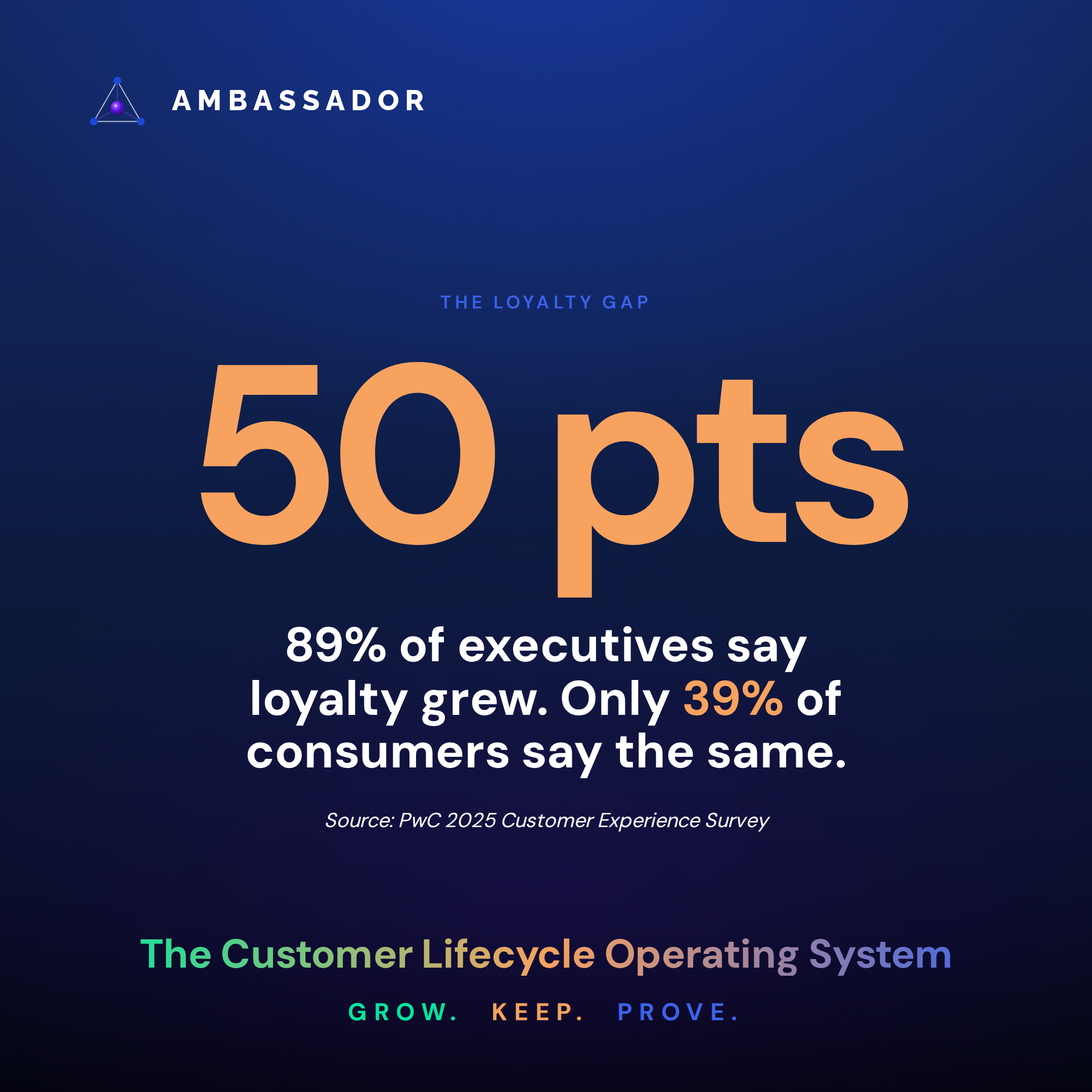
PwC's 2025 Customer Experience Survey, covering more than 5,500 consumers and about 400 executives, put numbers on it. 89% of executives said customer loyalty has grown in recent years, and only 39% of consumers said the same, as CX Dive reported when the survey came out. Nearly three in five executives also said their own loyalty programs fall short of what the business needs from them, and nearly half said they expect their program to be obsolete within three years.
PwC's George Korizis, speaking to CX Dive, put the gap down to what each side measures. Executives lean on numbers their own teams generate, such as renewals and usage, while customers judge loyalty by how the relationship feels. He added that customers tell PwC it gets decided "often the very first time they use the product."
Sit with that last point, because it changes where you look. If loyalty is decided at first use, then a dashboard that shows renewals is reporting a verdict, not a cause. By the time the renewal number moves, the customer made up their mind months ago, in a moment nobody was watching.
Fourth, where the profit actually goes
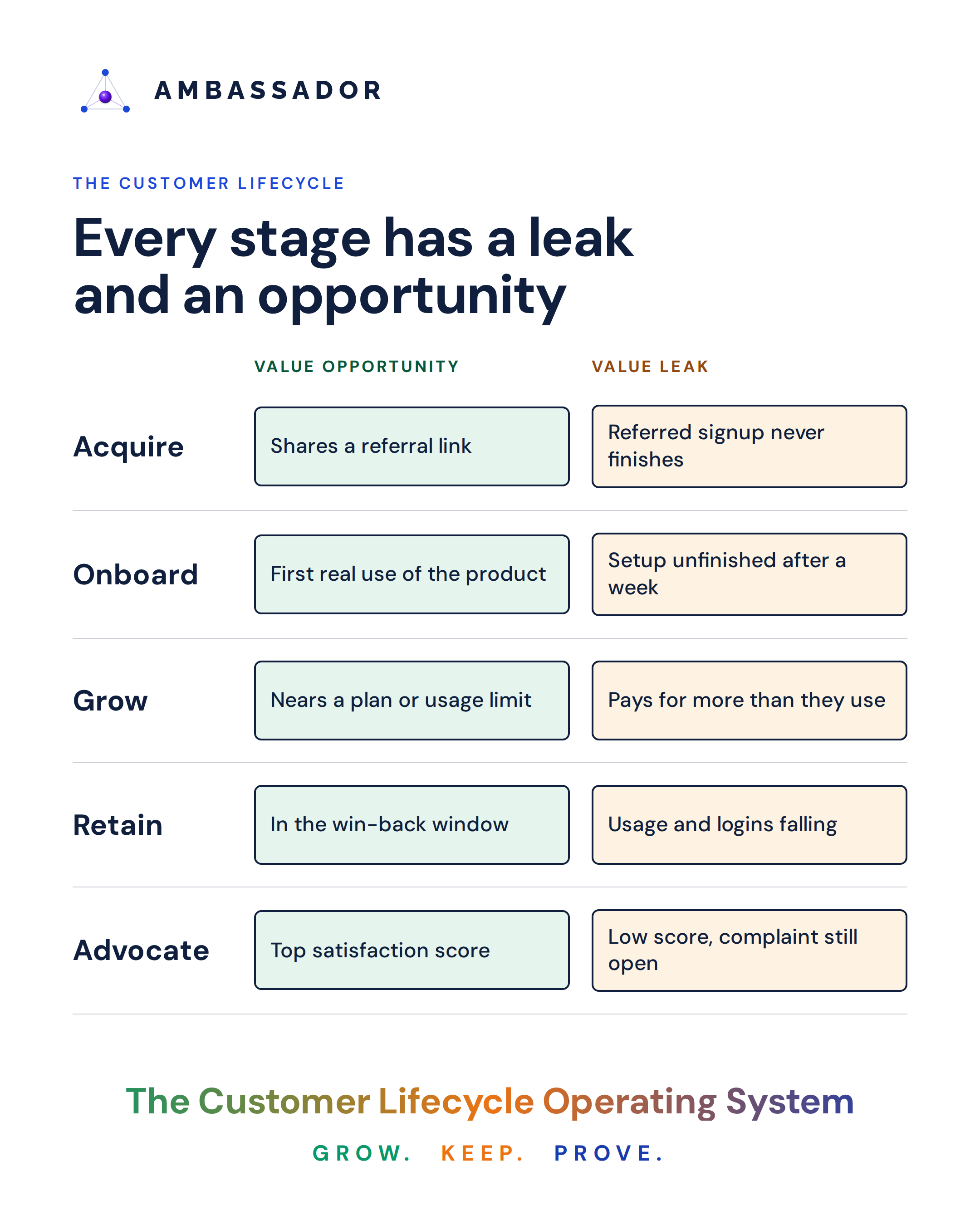
When a number like revenue per customer or churn misses, it rarely misses for one reason. It misses for many small ones, each too small to show up at the top of a report. A customer who never finished setup. A usage curve that bent downward three weeks ago. A customer who outgrew a plan and quietly started shopping. A happy customer nobody ever asked to refer a friend.
I find it useful to sort those into two kinds. A value leak is value you already have and are losing, and a value opportunity is value within reach that nobody is capturing. Both start with a signal: a customer behavior, recorded in a system you already run, that tells you which one you are looking at while there is still time to act. Billing, CRM, product usage, support, and surveys all throw them off. Every stage of the lifecycle has both kinds, and Korizis's first-use moment is one of them. Setup left unfinished after a week is exactly the leak he is describing.
You can test this on your own base this week. Pull the accounts that left last quarter and look at their first thirty days, then pull the same window for accounts that stayed. If the two groups already look different early, you have found a signal, and it was sitting in your data the whole time.
None of this data is exotic. In many companies it sits in different systems owned by different teams, and no one reads it together. I have sat in rooms where a file moving from one division to another takes three months to be acted on. When the work moves in sequence, everyone waits on the slowest handoff, and the leak keeps running the whole time.
Fifth, the part that moves money
A signal on its own is an observation. To become profit it has to be wired to an action, and I use five parts to check that it is: a goal, a signal, a source, an incentive, and an outcome. I call the package a signal set.
Here is an illustrative one for a carrier. The goal is keeping out-of-contract subscribers from porting out. The signal is a contract that has ended while data usage has fallen over the last thirty days. The source is billing for the contract and usage data for the drop. The incentive is a loyalty offer matched to the subscriber's plan and tenure. The outcome is a subscriber still active ninety days later, with the dollars protected counted against the goal.
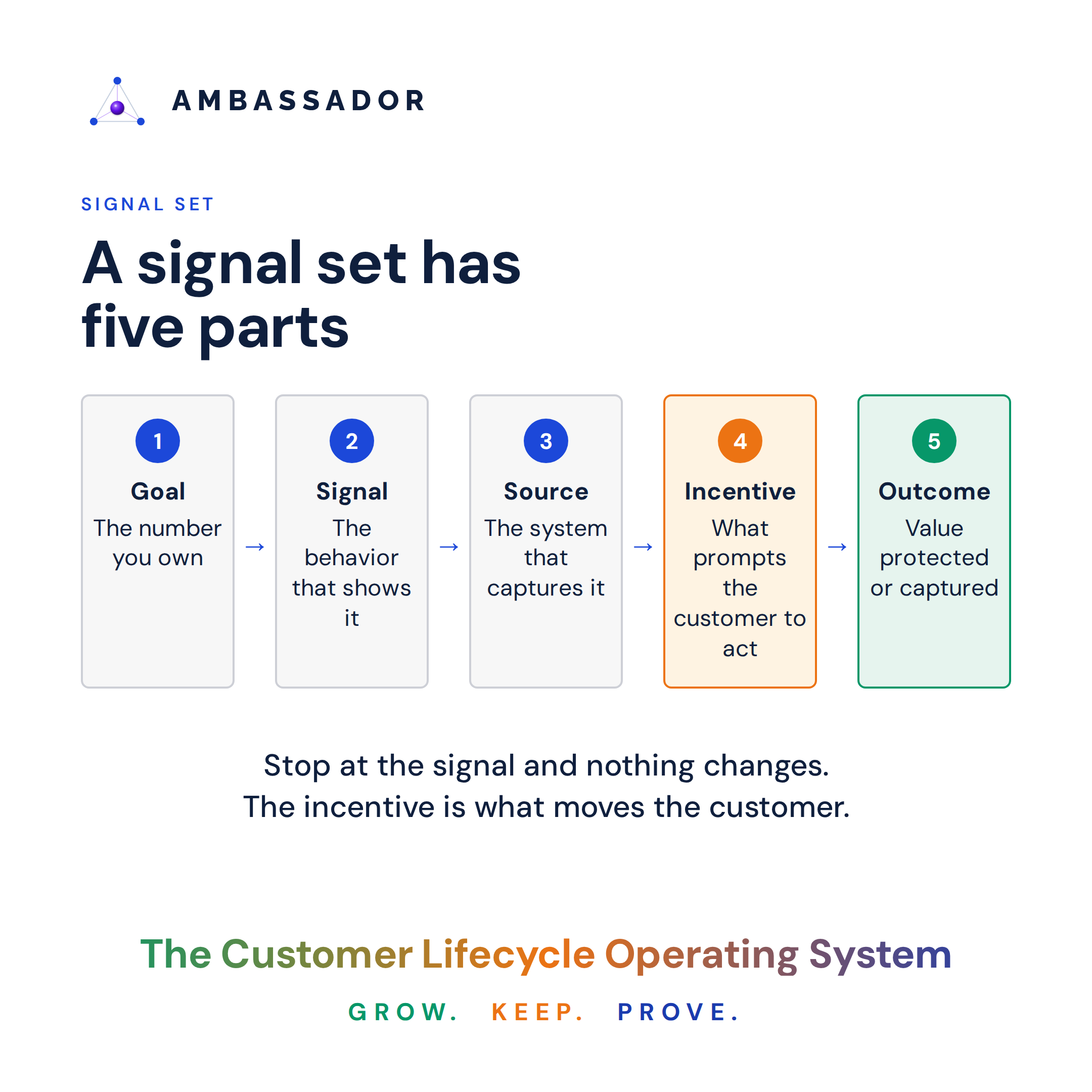
The fourth part is the one I would never skip. Most monitoring stops at the signal, and a signal alone has never changed a customer's mind. Something has to move them, and someone has to fund it, deliver it, and show it worked. That is why I trust the program numbers we see. In the programs we can attribute cleanly, ROI runs from 3:1 at the minimum to 5:1 or better at the best. Incentive redemption in our programs lands between 70% and 85%. Those are rates from programs we run, and your results will vary, but they tell me the incentive step is where the money is made or lost.
Then it loops. Each signal set keeps running, and what it learns about which signals, incentives, and channels work for your customers feeds the next one. I wrote about why most systems only ever own half of that loop in the half of the loop nobody owned, and about the architecture underneath it in the Lifecycle Operating System for customers and their agents.
Sixth, why I ask for the hard problem first
This is the part where I tell you how I have changed my own mind. For a long time I said yes to nearly every request that came in the door. I learned the expensive way that a vendor solving a small problem is the first line a budget cuts. These days, if a prospect cannot name a specific, hard problem, we do not chase it. It will not deploy, and it will not stay.
So I will ask you to do something before you talk to us, or to any vendor. Name the number you own and cannot move. Name the stage of the customer's life where you think it leaks. And ask yourself whether your finance lead would accept the way you plan to measure the result. If you can answer those three, you have a hard problem, and a hard problem can be solved, proven, and expanded. Two done properly beat four started.
Seventh, how to start without betting the year
Start small. Pick one or two signal sets on goals you already track, using data you already have. Prove it by measuring the outcome against a control group, a comparable set of customers who do not get the incentive, in your own numbers, so the result holds up when finance reviews it. Then scale: add signal sets across stages, markets, and brands, and automate whatever repeats.
The executive across the table is not asking anyone to be smarter. They are asking to be shown the money, in their own numbers, and shown it again next quarter. Lead with that, find the leaks one signal at a time, and prove every recovery.
Grow. Keep. Prove.
Ambassador is The Customer Lifecycle Operating System, orchestrated by HiroAI. It turns customer signals into incentive-driven outcomes. See how it works
Sources
- CX Dive, "Why leaders and consumers have different ideas about loyalty," September 29, 2025, reporting PwC's 2025 Customer Experience Survey: customerexperiencedive.com. Source of the 89%, 39%, nearly three in five, nearly half, and the Korizis quote.
- PwC's 2025 Customer Experience Survey page (primary): pwc.com.
- Carrier math: 10 million subscribers x 1% a month x 12 = 1.2 million subscribers. 1.2 million x $50 x 12 = $720 million. Labeled as an illustration in the copy.
- ROI 3:1 minimum and 5:1+ best, redemption 70 to 85%: approved Ambassador proof points, carried with their scope ("programs we can attribute cleanly," "programs we run").


