What I heard on a monetization webinar this week changed how I think about our competitive position. Not incrementally. Completely.
What I expected
The webinar was called "Monetization in Motion: Pricing Lessons for the Value Era." Metronome hosted it. Andrew Garvin, their co-founder and COO, interviewed Alexandra Demopoulos, Head of Monetization at Aiven.
That lineup matters. Metronome builds the usage-based billing infrastructure underneath OpenAI, Anthropic, NVIDIA, and Databricks. Stripe acquired them in January. Aiven runs managed open-source data infrastructure, which means their entire business already lives on consumption. These are not people theorizing about metered pricing. These are the people doing it at the largest scale it currently exists.
So I got on expecting to feel behind. I expected to hear that the AI-native cohort founded in the last two or three years had already solved consumption pricing, that outcome-based billing was becoming table stakes, and that those of us who started as SaaS companies were about to get lapped by companies with no legacy to defend.
That is not what I heard.
What I actually heard
Three moments reset my thinking.
First. Alexandra, on how Aiven prices its new AI capabilities: what they understand well is the cost element. What they do not yet understand is what unit represents a value that will scale with the customer's own perception of value. And then, without being asked to soften it, she said they are in a learning phase, and she was not going to hide it.
Sit with that. This is the Head of Monetization at a mature data infrastructure company with a dedicated monetization function. Not a seed-stage wrapper on somebody else's model. And her honest position is that she knows her costs and does not yet know her value unit.
Second. Asked whether outcome-based pricing is the final destination for all of this, she said it is more of an aspiration than a destination. Then she made the observation that reframed the entire category for me. So many companies are falling back on credits, she said, precisely because they struggle to define the outcome.
Credits are not a pricing model. Credits are a placeholder for a pricing model you have not figured out yet. Every credit system in the market right now is a company buying itself time, including, I should say, ours.
Third. Andrew, asked where this lands once the dust settles, did not say pure usage and did not say pure outcomes. He said hybrid. A defensible base plus a meter. He walked through why: if your long-term user is a high-powered human working alongside an agent rather than an agent operating alone, you can defend a seat and a usage charge sitting side by side. The company that builds the billing rails for the frontier labs thinks the end state is a floor with a meter on it.
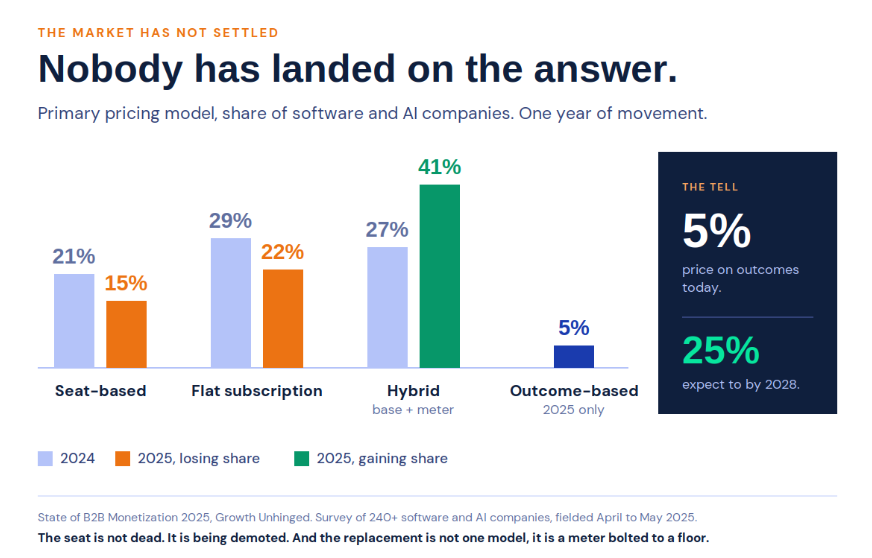
Pricing model shift, 2024 to 2025. Insert the image, then delete these two lines.
The data backs him up and it is worth staring at. Seat-based pricing fell from 21 percent to 15 percent of companies in a single year. Flat subscription fell from 29 to 22. Hybrid jumped from 27 to 41. And outcome-based pricing, the thing every conference panel treats as the inevitable destination, is the primary model at 5 percent of companies.
Nobody is converging on an answer. Everyone is running away from the old answer. Those are different things, and confusing them is how you end up rebuilding your pricing twice.
The realization
It took me most of the day to say this cleanly, so here it is.
Consumption pricing has two prerequisites. They are completely different in kind, and they arrive in opposite order depending on when your company was born.
The first is outcome knowledge. Knowing what your customer actually values. Not what they said they valued in the sales cycle. What actually made them renew in year three. What made them expand. What made them leave without telling you why. That is not a strategy exercise you can run in a quarter. It is sediment. It accumulates from years of watching customers succeed and fail at close range, and it exists nowhere except in the companies that have been there.
The second is metering infrastructure. The ability to measure the thing, rate it, invoice it, and recognize revenue on it. Andrew was specific about how hard this actually is. He described infrastructure companies managing hundreds of thousands of individual rates across regions, cluster sizes, and product lines, all changing constantly. He said the goal is to build it so that when you make a pricing update, it is not a migration. And he named the failure state directly, quoting a finance leader from Metronome's own research: the AI pricing logic lives in product code, finance sees a number in a dashboard once a month, and nobody in the building can explain how it got there.
Pricing model debt is engineering debt. That was his framing, and it is correct.
Now put the two prerequisites together and the competitive map redraws itself.
A company founded two or three years ago can build the second one clean. No legacy plan tables, no twelve-year-old billing schema, metering from day one. What it cannot do is manufacture the first one. It does not have the years. It is still delivering the application promise, still proving the product works at all, and it has to finish that before it can price what the product produces. That is not a criticism. That is a sequencing constraint, and no amount of funding removes it.
A company that has been selling software for a decade has the first one in abundance and mostly squandered it. It knows precisely what drives value for its customers. And it is still billing per seat, because that is what the billing system does and nobody wanted to open that up.
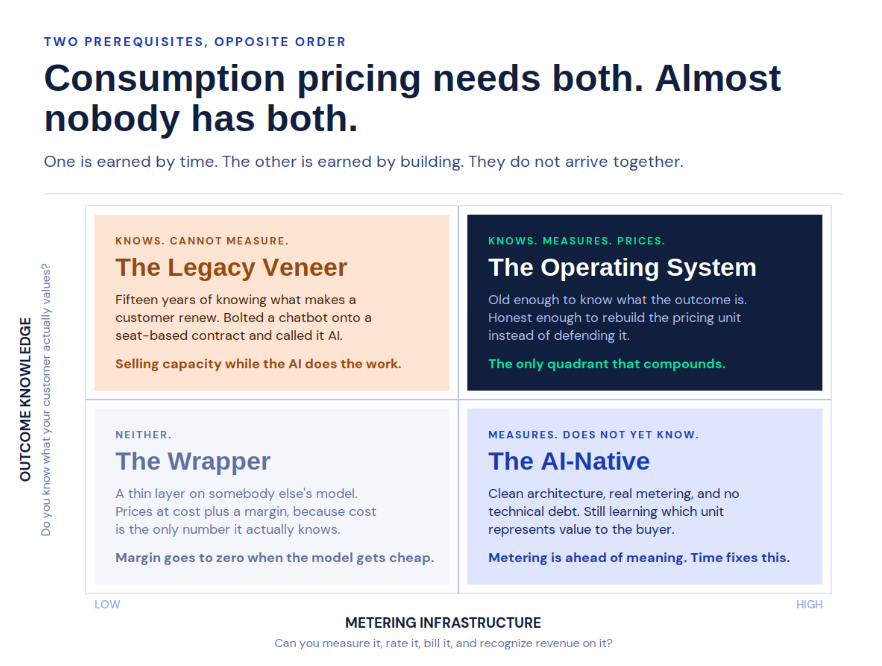
The two prerequisites and the four positions. Insert the image, then delete these two lines.
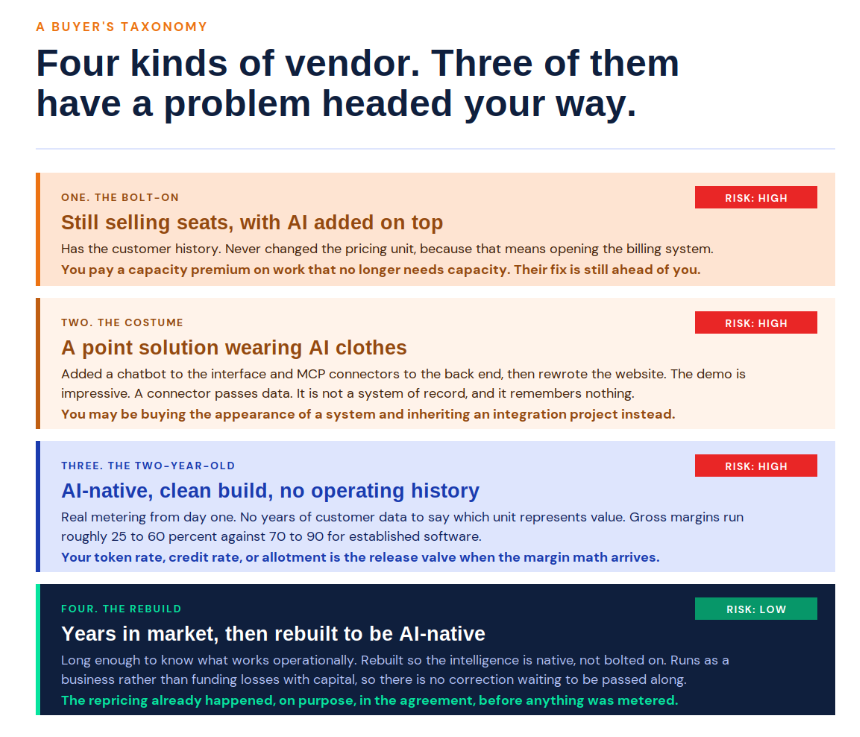
Four kinds of vendor, and three of them have a problem headed your way
That framework explains why vendors behave the way they do. This next part is the version I would want if I were the one signing the contract rather than the one writing them.
Sort your stack into four groups.
Four vendor types with buyer risk ratings. Insert the image, then delete these two lines.
One. The bolt-on
Has the customer history. Never changed the pricing unit, because changing it means opening the billing system nobody wants to touch. So the AI shipped and the meter stayed pointed at your headcount, your contact list, or your monthly actives.
This one looks the healthiest from the outside. Good margins, real customers, a press release about AI. But think about what it is actually doing. It is selling capacity by the head while the AI it just shipped reduces how many heads its customer needs. It is short its own product. Andrew put the sharp end of this on the table during the webinar: imagine the optimal way to operate your Salesforce instance becomes a single agent, or a set of them. What is a seat at that point?
And here is the part that matters if you are the buyer. Every efficiency that AI delivers shows up as a line item you are still paying full price for, because the meter is pointed at your headcount rather than at anything you would call a result. The savings land on the vendor's side of the table. You funded them. If your team is doing the same work with fewer people in the tool and your bill is flat or rising, you are paying a capacity premium on a workload that no longer needs capacity. Nobody sends you an invoice line called that. You have to go looking for it.
Two. The costume
This is the group I would look at hardest right now, because it is the easiest to mistake for the real thing.
A usage-priced tool or a single-purpose point solution adds a chatbot to the interface and a set of MCP connectors to the back end, rewrites the website, and starts describing itself as an AI company. The demo is genuinely impressive. Ask what it means for your company and the answer gets thin fast.
A connector is a way to pass data. It is not a system of record, it is not a closed loop, and it gives the tool no memory of what worked. You can wire a point solution to six systems and it will still not know why your last fifty customers churned, because nothing in that architecture was built to learn.
I want to be fair about MCP specifically, because I think the standard is real and useful and I am not interested in dismissing it. But it is early. The parts an enterprise actually needs around it are still being figured out: permissioning at scale, audit trails your security team will accept, predictable error handling, versioning when a tool changes underneath you, and governance that survives a procurement review. Anthropic, OpenAI, and everyone else working in that layer have real growing up to do before a pile of connectors adds up to an interconnected business. That is not a knock on any of them. It is just where the maturity curve actually is, and it is a long way from where the marketing is.
So the risk here is two-sided. You may be buying the appearance of an AI system and inheriting an integration project your team is not staffed for. And because nothing underneath the product actually changed, the pricing did not change either, which means the repricing conversation is still ahead of you.
Two questions worth asking in the next demo. What does this remember. And what happens when the connector on the other end breaks.
Three. The two-year-old
This is the group I assumed was ahead, and this is where I was most wrong.
They built real metering from day one. Clean architecture, no legacy schema, no technical debt. What they do not have is the years of customer data that tell them which unit actually represents value, so they are still working it out. And they are working it out on thin margins. AI-native gross margins run roughly 25 to 60 percent against 70 to 90 for established software, with a meaningful share of revenue going straight back out on inference.
A finance leader quoted in Metronome's own research put it plainly: they are not monetizing AI to grow revenue, they are monetizing to stop absorbing thousands of dollars in cost on a small plan. That is defensive repricing. And when a vendor reprices defensively, the release valve is your token rate, your credit rate, or your included allotment.
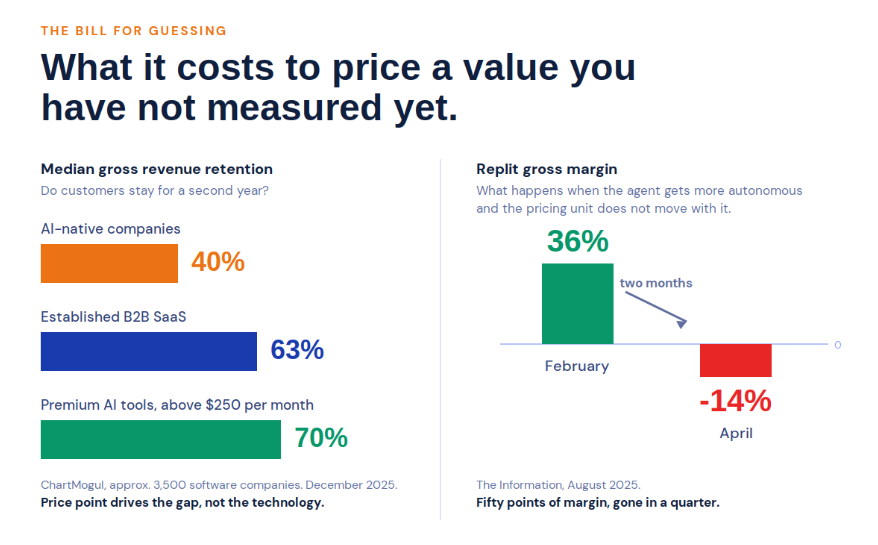
It is already happening in public. Replit's gross margin went from 36 percent in February to negative 14 percent in April after it shipped a more autonomous agent while the pricing unit stayed where it was, and it moved to effort-based pricing. Cursor changed how usage was billed, generated a backlash, and its CEO apologized and refunded customers. GitHub Copilot moved from flat per-request pricing to token-denominated credits, and some heavy users reported bills many times higher.
None of those companies are careless. They are among the best-funded and best-staffed teams in software. The margin math simply arrives whether or not anyone is ready for it.
Four. The rebuild
Operating in market long enough to have the customer data that shows what actually works, and what makes a program succeed in year three rather than in a pilot. Then rebuilt so the intelligence is native rather than bolted on.
There is one more part of this that gets overlooked, and it is the part I would weight most heavily as a buyer. Running as a real business rather than funding losses with capital. A vendor covering negative gross margins with someone else's money has a correction coming, and when it arrives you are in it. A vendor that has had to operate sustainably has already made those decisions, which means the decisions are behind them rather than in front of you.
This is where we sit, and I will get to what we actually did in a moment.
So the question worth asking is not which pricing model is fashionable. It is whether the vendor you are paying has a problem headed toward you, and whether you are the one who absorbs it. Three of those four groups do. One does not, and the reason is sequencing and operating history rather than cleverness.
What getting this wrong actually costs
AI-native margin and retention gap. Insert the image, then delete these two lines.
Median gross revenue retention for AI-native companies sits around 40 percent, against roughly 63 percent for established B2B SaaS. Premium AI tools priced above $250 a month hold about 70 percent. Read that last number carefully, because it tells you the gap is driven by price point and buyer seriousness, not by the technology.
Salesforce has shipped three distinct Agentforce pricing models in roughly eighteen months, moving from per-conversation to action-based credits to per-user digital labor licensing. That is not indecision. That is a very capable company discovering in public that it does not yet know what unit to charge for.
These are the best-resourced teams in software getting this wrong repeatedly, because they are pricing a value they have not measured yet.
The move that actually works right now
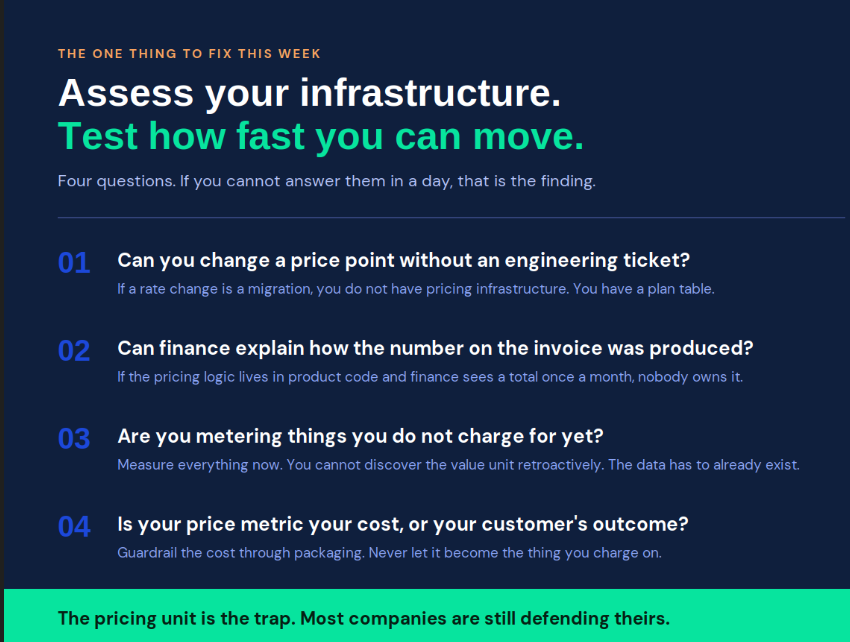
When Alexandra was asked what a company should go fix this week, her answer was not a pricing answer at all. It was: assess your infrastructure, and test how quickly you can make a pricing move.
That is the whole thing. Not what should we charge. How fast can we change what we charge.
And her actual play at Aiven is the strategy in one sentence. They are not charging on outcomes yet. But the metering is happening anyway.
Measure now. Price later. You cannot discover your value unit retroactively. If you are not instrumenting customer behavior today, the dataset you would need in eighteen months to find your value metric does not exist, and no amount of strategy work in eighteen months conjures it into being. Her framing on this was blunt and I am adopting it: measure everything, whether or not you currently intend to use it.
One more discipline point, and it is the one I see violated most. Your cost is not your value metric. When costs are high there is real comfort in cost-plus, but it leaves money on the table and it makes your value impossible to defend in a renewal. Guardrail the cost through packaging and limits. Price at the value. The moment you charge on tokens, you have told your customer that your product is tokens, and you will never win that conversation again.
Why we price on consumption, and who we built it for
I am going to be specific about our own position now, partly because it is the honest thing to do after criticising everybody else, and partly because our customers have been asking us this exact question and deserve a clearer answer than they have been getting.
We are building the first Customer Lifecycle Operating System. Not a referral tool with AI added, not a loyalty app with a chatbot on the front. One system where acquisition, retention, and proof run as a single closed loop, with HiroAI orchestrating it. That does not exist anywhere else yet, which means parts of this are genuinely new ground, and we would rather be open about that as we work through it than let anyone discover it later.
Pricing was the first thing we decided we had to get right, because it is the thing that quietly determines whether a platform helps you grow or taxes you for growing.
What we kept hearing
Customers were tired of buying a full standalone platform for something they used a handful of times a year. A survey tool. A reviews tool. A referral point solution. Annual contract, annual invoice, and honestly used in March and maybe again in September.
And every time a vendor shipped something new, it arrived as another line item. A new module fee. A new platform fee with usage stacked on top. Sometimes a new contract just to get access to something the vendor had already finished building.
Both of those are the same move. One lands you as a point solution and charges you for a year of capacity you use twice. The other lands you on a platform and charges you again each time the platform grows. Either way the vendor's revenue goes up when their product list gets longer, not when your results do.
So we built it the other way around
You get what you need, when you need it, and you pay for it when you consume it.
Want to run a survey three times a year? You should not have to buy a survey platform to do that. You consume when you send, and three times means three times. When we ship a new capability it lands inside the framework you already have rather than arriving as a negotiation. When you use something occasionally you pay for what you actually consumed rather than for a year of standing capacity. And the meter points at intelligence work rather than at your headcount or your list size, so growing does not automatically cost you more.
The mechanism is one currency instead of a separate meter per capability. Ambassador Credits cover intelligence work across the platform. Capabilities roll out over time and nothing here is a commitment to a specific release date, but the framework is designed so that new work has somewhere to land without a new contract.
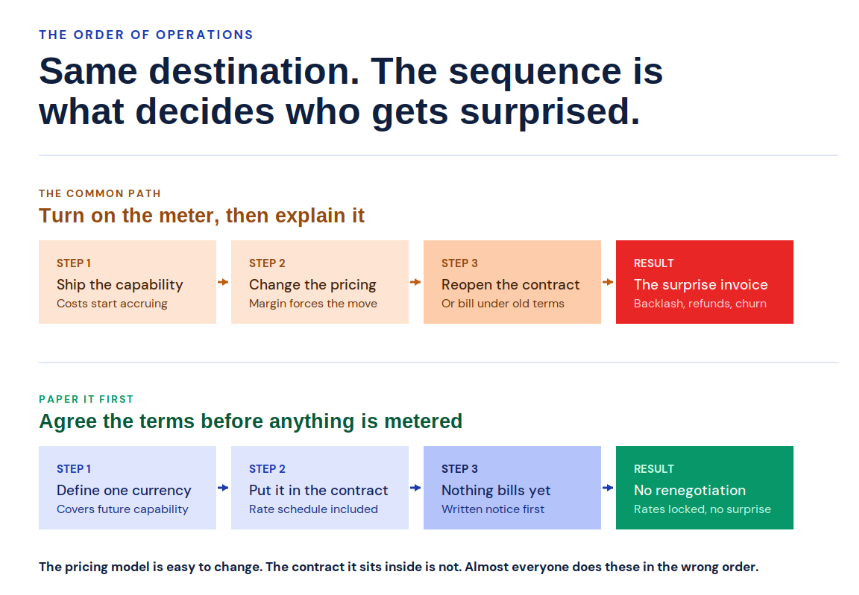
And we are not metering consumption yet. Our order forms state that plainly. Nothing consumption-based bills unless and until we enable it for a given capability, with advance written notice, and the rates for what a customer already has are fixed for the remainder of their term when we do.
We papered the model before we had turned anything on.
Two routes to consumption pricing. Insert the image, then delete these two lines.
That is the part I would push back on if I were on the other side of the table, so let me answer it directly. We wrote the model down before turning it on precisely so that the day it goes live is not the day anyone finds out what it costs.
Solving for the customer, and being honest about the business
This came out of listening rather than out of a pricing exercise. It solves the customer's problem first, and I am not going to dress that up as generosity, because a vendor that loses money on you is a vendor with a correction coming and you would be the one funding it. The only version of this that holds up over time is one where the customer's objective and a healthy business point in the same direction. That is what we were aiming at, and it is why I think this is where AI pricing ends up across the category rather than just at our end of it.
What we are seeing from the customers who run this as an operating system rather than as a set of separate programs is a real gap against the old platform. Net-new revenue from existing client conversions runs 17 percent on the new platform against 4 percent on the prior generation. Standout upsell results among migrated customers reach as high as 142 percent, and I want to be clear those are best cases rather than averages.
I also want to be clear about the limits. We have not solved consumption pricing. Nobody has, which was the entire point of the webinar. Our metering is a build in front of us, not behind us. There are units in our own pricing I am not fully satisfied with, and our contacts model is under active review internally for exactly the reason I described earlier in this piece. Anybody who tells you they have this finished is selling you something.
What I will claim is narrower and I think more useful. We know what our customers value, we agreed the pricing framework before we turned on the meter, and we are building the system that pricing was designed for.
Four questions worth asking, whoever you buy from
None of this is useful as commentary. It is useful as a set of questions you can put to any vendor in your stack, including us.
Four diagnostic questions. Insert the image, then delete these two lines.
Ask whether the unit they bill you on goes up when your results go up, or when your headcount does. Ask why you are still paying per person who logs in, if their AI is doing the work. Ask whether you can see consumption in a dashboard before it appears on an invoice, and whether your rates are locked for the term. Ask whether you need a new contract when they ship something new. And if they are showing you connectors, ask what the system remembers and what happens when one of those connectors breaks.
The SaaSpocalypse, stated correctly
People keep saying SaaS is dying. That framing is lazy and it is costing people clear thinking.
Software is not dying. Seat-priced software with no metering layer is dying. And the companies most exposed are not the oldest ones. They are the ones that added AI to a pricing model that bills for capacity while the AI removes the need for capacity, and the ones that added a chatbot and some connectors and hoped nobody would ask what changed underneath.
Meanwhile the AI-natives have a clean pricing architecture aimed at a value unit they cannot yet define, and a retention profile that says their customers have not decided this is infrastructure yet.
The scarce combination is knowing and measuring. Almost nobody holds both, and the market is pricing as if the second one is the hard part. It is not. The second one is a build. The first one is a decade.
There was one last thing from the webinar I have not stopped thinking about. Andrew observed that the people most in demand at the top AI companies operating today are the ones who dealt with monetization in the prior SaaS era, because they have already lived through the problem the frontier labs are hitting now.
The person who builds the billing rails for the frontier labs is telling you that SaaS-era experience is the scarce asset in AI monetization. That is not a consolation prize for incumbents. That is the moat, for any incumbent willing to actually use it.
The years are not the liability. Defending the seat is.
Geoff McDonald is the CEO of Ambassador, The Customer Lifecycle Operating System, orchestrated by HiroAI.
Sources
- "Monetization in Motion: Pricing Lessons for the Value Era," Metronome webinar. Andrew Garvin, Co-founder and COO, Metronome. Alexandra Demopoulos, Head of Monetization, Aiven.
- State of B2B Monetization 2025, Growth Unhinged. Survey of 240+ software and AI companies, fielded April to May 2025.
- ChartMogul retention dataset, approximately 3,500 software companies. December 2025.
- The Information, reporting on Replit gross margin. August 2025.
- Metronome 2025 field report on usage-based pricing adoption.
- Bain & Company, "Per-Seat Software Pricing Isn't Dead, but New Models Are Gaining Steam." October 2025.