By Geoff McDonald, CEO, Ambassador
Every year around this time, I read the stack of customer research that lands before the holidays. This year something stood out. Reports from different firms, asking different questions, all point in the same direction.
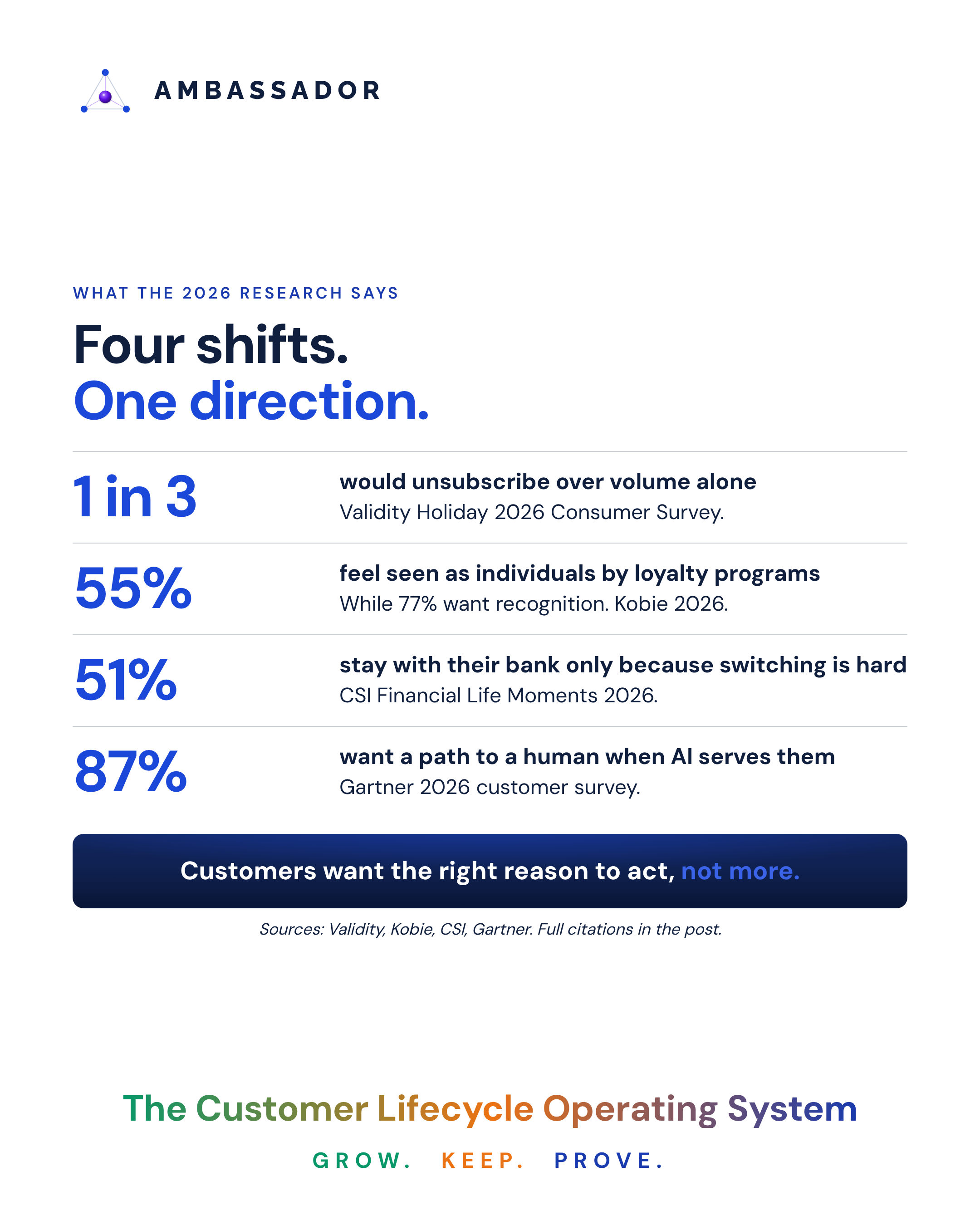
Here's the short version. The research says four things are changing at once:
- Customers are tuning out volume. More messages are costing brands attention, trust, and in some cases the channel itself.
- Customers want to be recognized, and money is only one way to do it. Recognition, access, and relevance are pulling ahead of the generic discount.
- Loyalty is softer than most dashboards show. A large share of customers stay because leaving is hard, and how a brand makes them feel is doing more of the work.
- AI is expected to be the how, never the why. Customers and enterprise buyers are both pushing back on AI that gets in the way.
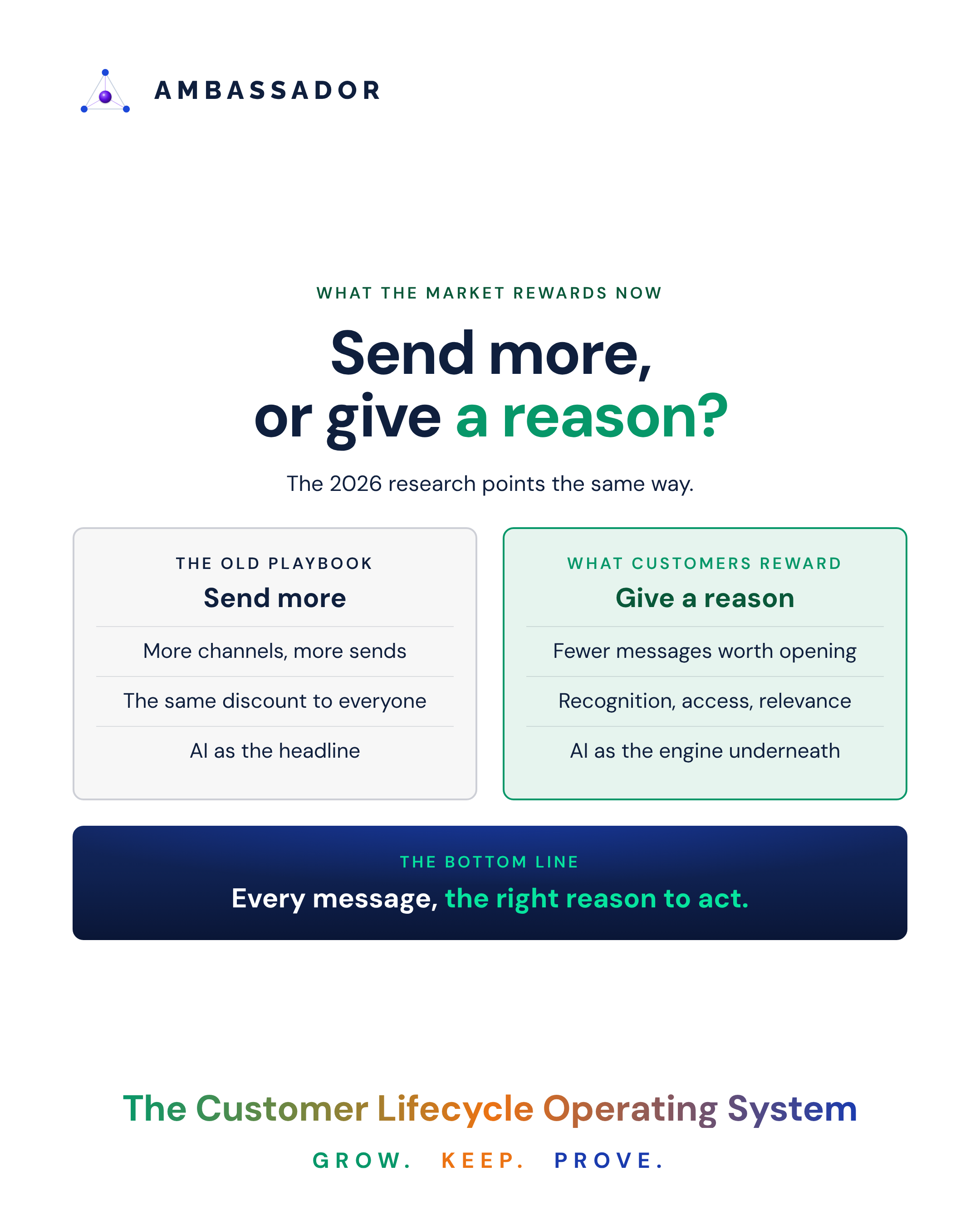
Put those together and you get the strategy we've been building toward at Ambassador: every message, the right reason to act.
Customers are tuning out the volume
Start with the inbox, because that's where most customer relationships actually live.
Validity surveyed 1,000 consumers for its Holiday 2026 Consumer Survey. One in three said holiday email volume alone would make them unsubscribe from a brand. And 36% said they've missed an important, non-promotional message because it was buried under promotions.
Think about what that second number means. A receipt, a renewal notice, a fraud alert, lost in the brand's own noise.
For a decade, the marketing stack has been built to send more: more channels, more automations, more sends. The research says the customer stopped rewarding that a while ago. We wrote about where these leaks show up across the lifecycle in Close the Leaks, and the pattern holds across every report I read this fall.
Customers want to be recognized
The second shift is about what a reward actually is.
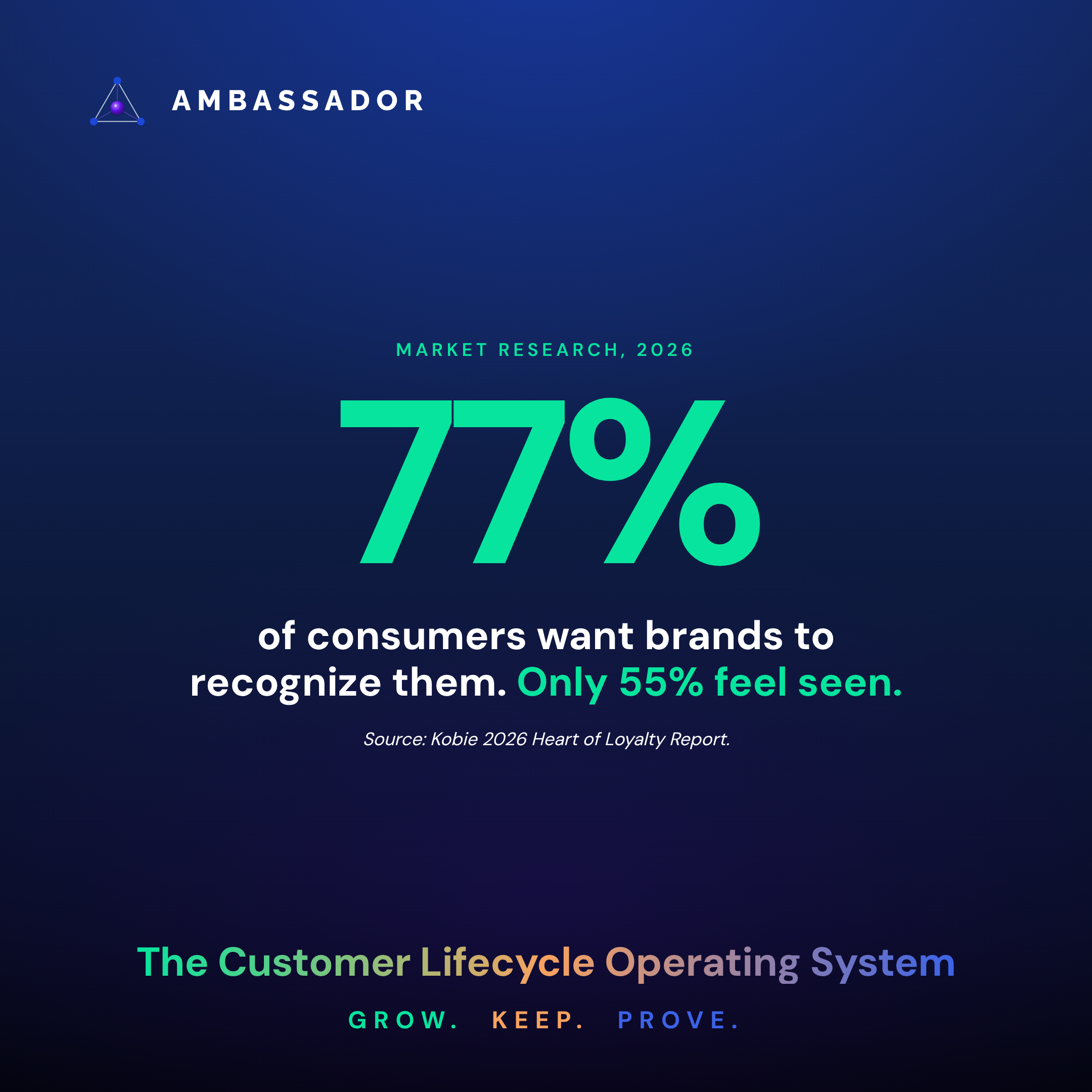
In Kobie's 2026 Heart of Loyalty Report, 77% of consumers said they want brands to recognize them in some way. Just 55% said the loyalty programs they belong to treat them as individuals. What people remembered most were small, personal touches, like an unexpected reward or a note on a membership anniversary.
Merkle's 2026 Loyalty Barometer points the same way. The biggest year over year gains in what consumers value came from exclusive access and personalized recommendations, and Merkle concludes the personalization gap is "a design problem," not a data shortage.
That matches how we think about incentives. People act on six kinds of reasons:
- Money: a credit, cash back, a gift card.
- Access: an early feature, an upgrade, a perk.
- Status: a tier, recognition, a badge.
- Voice: feedback that shapes what gets built.
- Help: a problem fixed before they ask.
- Time: fewer, better messages.
Most brands default to the first one, sent to everyone, on a calendar. When the reward fits the person and the moment, people use it. On Ambassador, program incentive redemption runs 70 to 85%.
Loyalty is softer than the dashboard says
The third shift is the one that should worry every board in telco and financial services.
CSI's Financial Life Moments 2026 study found that 51% of bank and credit union account holders stay with their institution only because switching feels hard. Another 40% have considered switching because they felt unsupported during a major life event. That's a lot of revenue resting on friction, and friction keeps getting easier to remove.
Telecom tells a similar story in different units. AT&T reported postpaid phone churn of 0.92% a month for the third quarter. At that rate, roughly one in ten phone customers leaves over a year, even at one of the best operators in the world.
Forrester's 2026 US CX Index adds an important piece. Customer experience quality ticked up for the first time since 2021, and Forrester says emotion led the rebound. Scores are still slightly below 2024 levels, and credit card issuers were one of only three verticals to decline this year.
How a brand makes a customer feel is doing real work. Known, appreciated, looked after. Those feelings come from small moments answered at the right time, which is exactly where most programs leak.
AI is the how, never the why
The fourth shift is the one I hear most in enterprise conversations.
Gartner's 2026 survey of 3,566 respondents found that 87% say companies using generative AI for customer service must keep a path to a human agent. In separate research, Gartner found half of U.S. consumers would prefer to buy from brands that avoid generative AI in consumer-facing messages and content.
The buyers are just as cautious. McKinsey's State of AI 2026 found only about 6% of companies qualify as AI high performers, and the share reporting any EBIT impact from AI barely moved from the prior year.
So customers want AI to stay out of the way, and enterprise buyers want proof before they open their data. Both are telling vendors the same thing: lead with the customer and the result, and let AI be the engine underneath. It's why we talk about HiroAI as the orchestrator, not the headline.
What it adds up to
Line the four shifts up and they describe one model, built from the bottom up:
- Communication. Can you reach the customer at all, with a message worth opening? Validity's numbers live here.
- Incentives and value. Is the reward the right kind, sized to the moment? Kobie and Merkle live here.
- Signals and timing. Do you know who to act on, and when? CSI's life-event finding lives here.
- Orchestration. Does it all run as one journey instead of five teams shouting?
- Proof and learning. Can finance see what it returned? McKinsey's flat EBIT number is the warning.
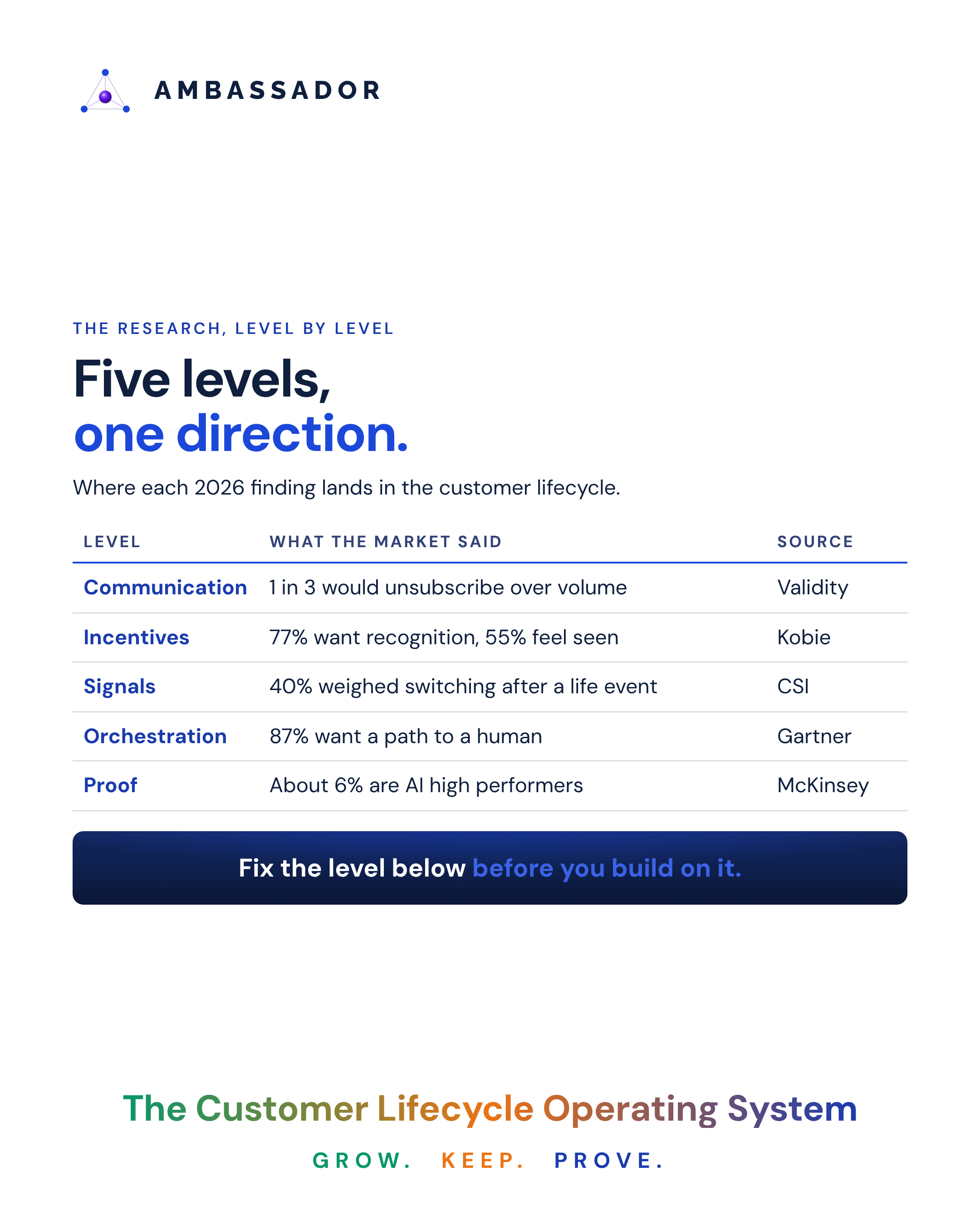
This is the direction Ambassador is headed, and it's why our starting point with every client is the base of that list. Before anyone touches orchestration or AI, we look at the messages a brand already sends and whether they give the customer a reason to act. Then we earn the next level.
The platform is built around that same order: the voice is the message, the reason is the incentive, and HiroAI decides who gets what, and when. Everything gets measured, which is how we've attributed more than $2.4 billion in revenue to date.
The bet
The brands that win the next five years won't be the ones that send the most or bolt on the most AI. They'll be the ones that show up for customers the way a good friend would: on time, with something worth having, and with proof it worked.
Every message, the right reason to act.
Grow. Keep. Prove.
Ambassador is The Customer Lifecycle Operating System, orchestrated by HiroAI. We help enterprise brands give every customer message the right reason to act, starting with the communication layer every other level depends on. See how it works.