"We don't even get these kinds of results from The Trade Desk... this is the best-performing programmatic we have had... we are going to continue to increase our budget throughout the year."
An Ambassador Programmatic customer, from a reply to their monthly report
Today, programmatic advertising is officially part of Ambassador. Not integrated with. Not connected to. Inside.
That distinction is the whole announcement, so let us earn it.
The problem with programmatic is not the ads. It is the amnesia.
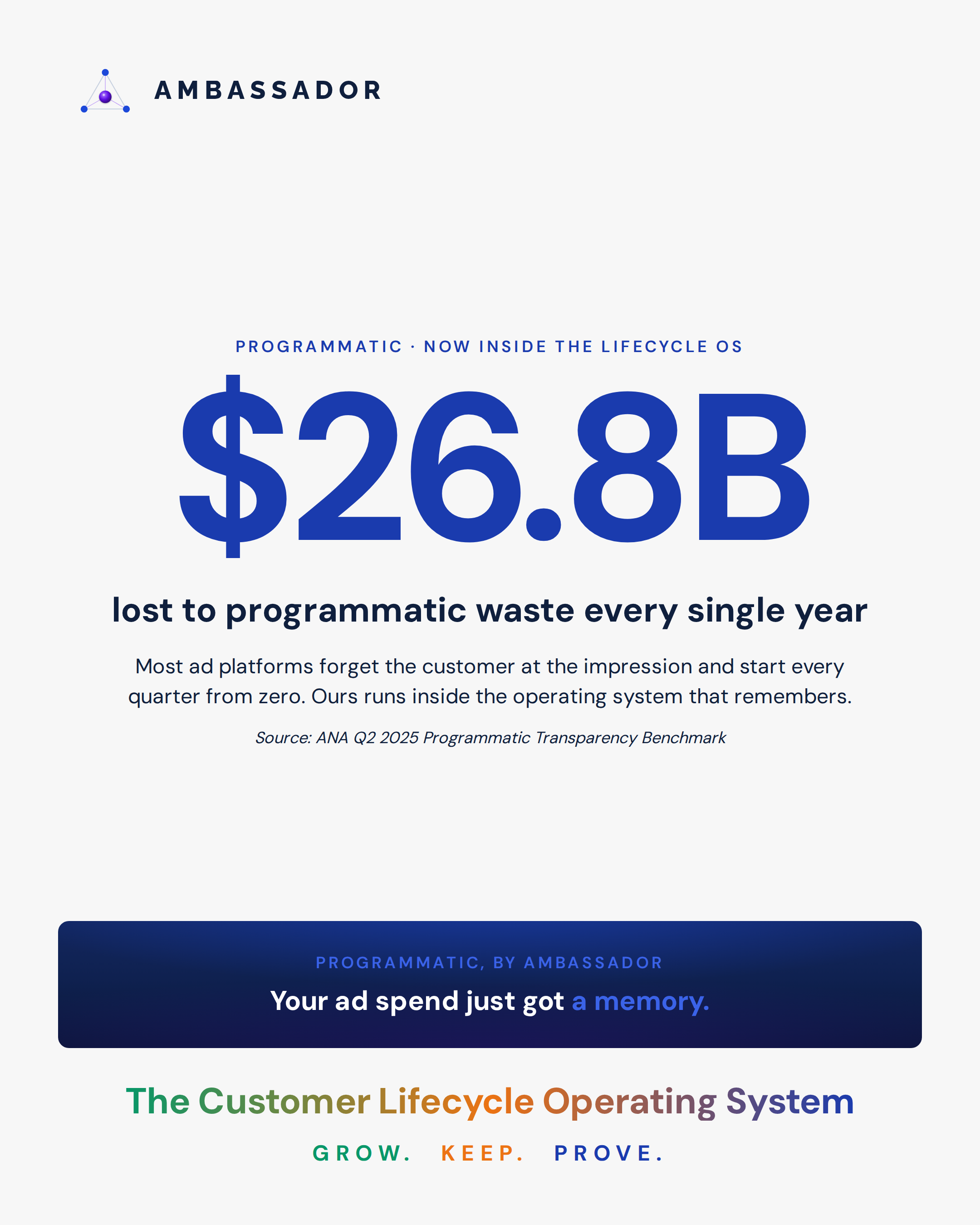
The ANA's Q2 2025 Programmatic Transparency Benchmark counted $26.8 billion in global media value lost to programmatic inefficiency every year. Their landmark supply chain study found the same story in the details: roughly one in four open web programmatic dollars is wasteful or unproductive, and made-for-advertising junk sites alone captured 21 percent of tracked impressions.
Those numbers get blamed on fees and fraud, and both play a part. But the structural cause is simpler: the platform spending your money cannot see what happens after the click. It optimizes toward the only thing it can see, an impression and a click, then forgets the person entirely. Next quarter it buys the same strangers again. You pay for the same lesson every 90 days, forever.
Rented reach resets to zero. That is not a pricing problem. It is an architecture problem.
What changes when programmatic lives inside the operating system
Ambassador is The Customer Lifecycle Operating System:
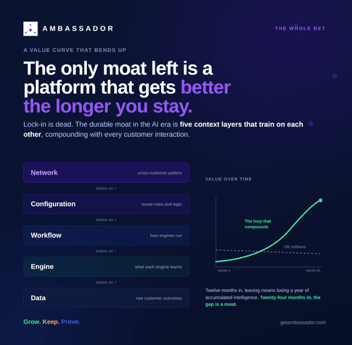
One orchestrator, nine engines, one memory of what actually worked for every customer. Programmatic is the ninth engine, and being inside the system changes four things a standalone platform structurally cannot do.
-
Conversions are measured twice, on purpose. A browser-side pixel teaches the campaign to optimize toward your real conversion events, and a server-side record ties every conversion to your actual orders, with exact revenue, in a way that survives ad blockers, consent gaps, and browser tracking restrictions. The platform number makes the campaign smarter. The server-side number is the truth you report. Most setups give you one or the other. You get both, reconciled.
-
Paid and advocacy share one attribution system. An ad conversion in Ambassador sits in the same attribution model as your referral conversions. When a paid click and a customer referral touch the same buyer, you see it, instead of two platforms each claiming full credit and you paying twice for one win. No standalone DSP can do this, because no standalone DSP can see your referral program.
-
Retargeting starts on day one. Page-based audiences are live: cart visitors, product page viewers, pricing page readers, any intent signal your site produces. Consent-aware by design, respecting the visitor's privacy signals on every fire. And there is no minimum audience size gating you; a focused audience serves from the start.
-
Your first-party advantage finally gets used. Boston Consulting Group and Google found that brands using first-party data for key marketing functions achieved up to a 2.9x revenue uplift and 1.5x cost savings. Your Ambassador account is already the system of record for who converted, who stayed, and who advocated. Programmatic inside the OS is that advantage, pointed at acquisition.
How it works in practice
If your revenue closes in a CRM (considered purchases, B2B): the ad click is captured on landing, the lead fires when the form completes, and when the deal closes weeks later and syncs to Ambassador, the conversion still attributes to the campaign that earned it. The click-to-close gap that breaks most ad measurement is exactly what the persistent attribution model is built for.
If your revenue closes at checkout (e-commerce, including Shopify and WooCommerce): the purchase conversion fires on your confirmation page and the server-side record carries the real order revenue. The campaign optimizes on actual buyers, not proxy clicks.
How to start: the 90-day test
We are not asking you to move your programmatic budget to Ambassador. We are asking you to run a test that costs you nothing structural.
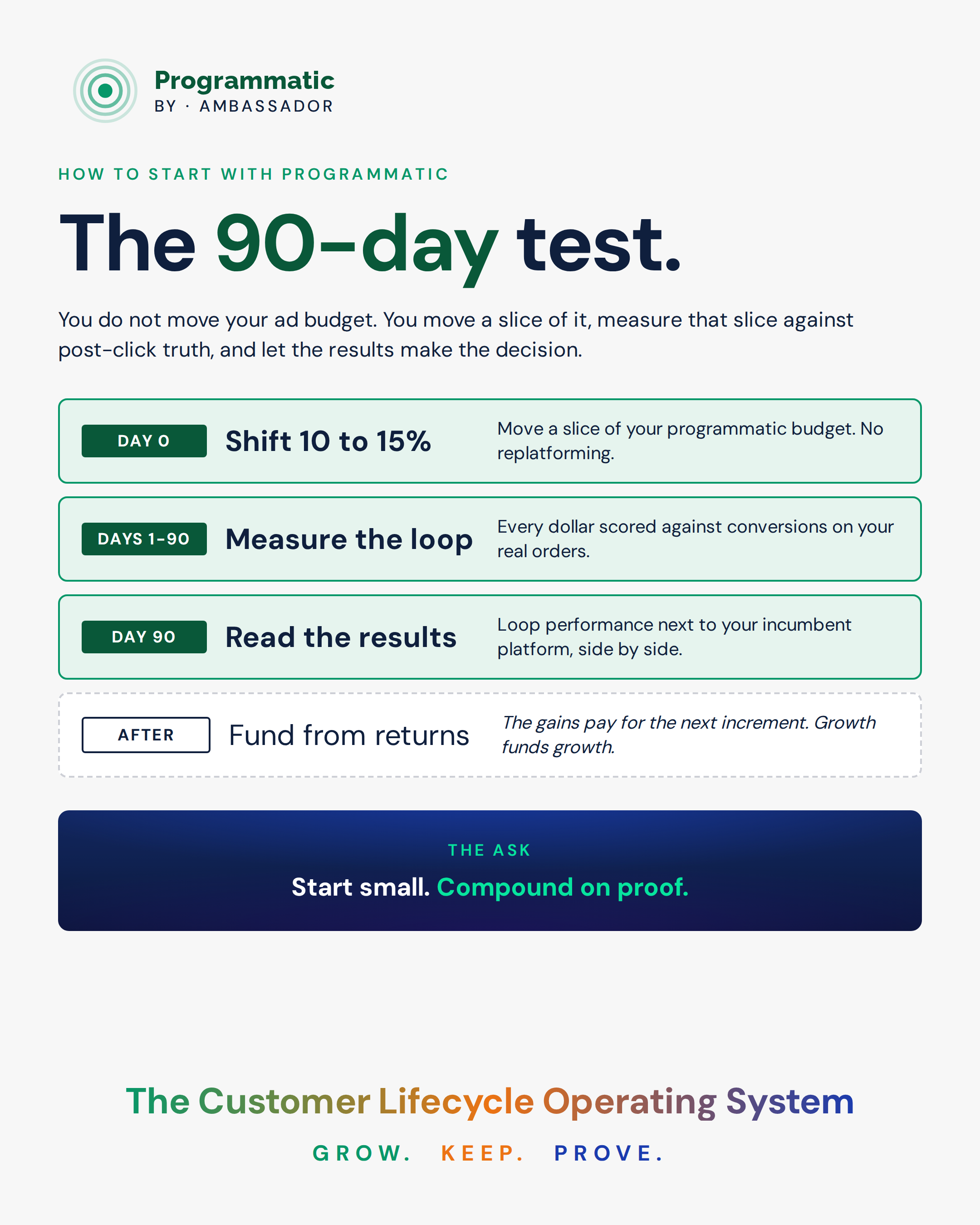
Move 10 to 15 percent of your programmatic budget into Ambassador for 90 days. Keep the rest exactly where it is. No replatforming, no agency change, no all-in bet.
Measure the slice against post-click truth. Every dollar reports against conversions recorded on your own orders, tied to the campaign that earned them, next to the retention behavior that followed. At day 90, put the loop's performance beside your incumbent platform's and read the answer.
Then let the results make the decision. If the loop outperforms, the gains fund the next increment; growth pays for growth, and your incumbent budget never had to be touched. If it does not outperform, you kept 85 to 90 percent of your budget where it was and you learned something real about your funnel either way.
The customer at the top of this page ran that exact motion. The quote is what happened next.
What is live today, and what is next
Live now: programmatic campaigns with lead and purchase conversion tracking, server-side conversion records with exact revenue, page-based retargeting audiences, consent-aware tracking, and Shopify and WooCommerce support. In development: estimated audience reach previews for campaigns. We would rather tell you the edges plainly than let a demo imply them away.
Start the test
Book a strategy session and we will scope your 10 to 15 percent slice, the audiences to start with, and the exact conversion events we will measure it on. Ninety days later, the data decides.
GROW. KEEP. PROVE.
Sources
- ANA, Q2 2025 Programmatic Transparency Benchmark: $26.8B in media value lost annually to programmatic inefficiency (ana.net, Aug 14, 2025)
- ANA, Programmatic Media Supply Chain Transparency Study, Complete Report (Dec 2023): ~25% of open web programmatic spend wasteful or unproductive; MFA sites at 21% of tracked impressions
- Boston Consulting Group and Google, first-party data research: up to 2.9x revenue uplift and 1.5x cost savings from first-party data in key marketing functions (bcg.com; thinkwithgoogle.com)